
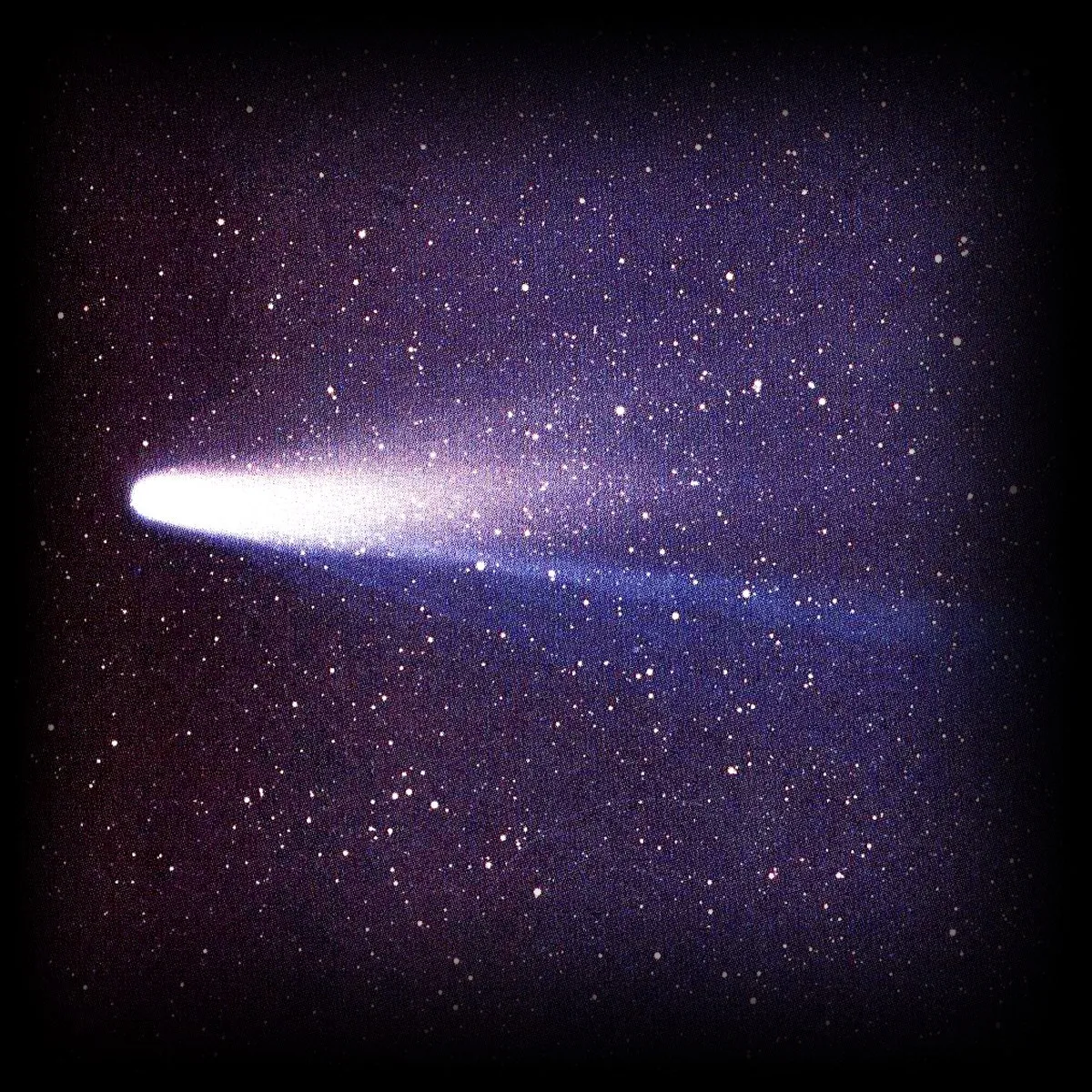
Halley's Comet (1P/Halley)
Halley's Comet returns about every 76 years. It last passed the Sun in 1986 and will be back in July 2061. Its dust causes the Orionid meteor shower.
NASA/W. Liller
The first comet anyone predicted would come back, and it did.
Halley’s Comet, officially 1P/Halley, is the most famous comet in history and the only bright periodic comet you could see twice in a lifetime. It returns to the inner solar system roughly every 76 years. It last passed the Sun on 9 February 1986, and its next perihelion is due on 28 July 2061.
When is Halley’s Comet coming back?
Halley’s next closest approach to the Sun is on 28 July 2061. The comet reached the far end of its orbit, about 35 au from the Sun (beyond Neptune), in December 2023, and is now falling back towards us.
The 2061 return should be much better for viewers than 1986. Then, Earth and the comet were on opposite sides of the Sun at the key moment, and the comet came no nearer than 0.42 au (63 million km). In 2061 the comet and Earth will be on the same side of the Sun, so it is expected to appear considerably brighter, although exact predictions of a comet’s brightness are always uncertain.
How long is Halley’s orbit?
Halley takes about 76 years on average to orbit the Sun, but the gravity of the planets, especially Jupiter and Saturn, stretches or shortens each lap. Measured between perihelia, the period has been as short as 74.42 years (1835 to 1910) and as long as 79.25 years (451 to 530).
The orbit is extremely elongated, with an eccentricity of about 0.97. At perihelion the comet comes to about 0.59 au from the Sun, inside the orbit of Venus; at aphelion it is about 35 au away. It also travels backwards (retrograde), opposite to the direction of the planets, in an orbit tilted about 18 degrees to Earth’s. You can see why it speeds up so much near the Sun in Kepler’s laws and vis-viva.
How big is Halley’s Comet?
The solid nucleus is shaped roughly like a peanut or potato, about 15 km long and 8 km wide. It is one of the darkest objects in the solar system, reflecting only about 3 to 4% of the light that hits it, because a crust of dark, carbon-rich dust covers its ice.
Its mass is estimated at around 2 × 10¹⁴ kg, but this figure is uncertain because no spacecraft orbited it. The density is thought to be low, perhaps 0.6 g/cm³ or less, so the nucleus is probably a porous mix of ice and dust. Its rotation is complicated: it tumbles, with periods of about 2.2 days and 7.4 days combined.
Near the Sun, ice turns to gas and bursts out in jets, building a coma of gas and dust and tails millions of kilometres long.
Why is it called Halley’s Comet?
Until the late 1600s, most people thought comets passed through the sky only once. In 1705 the English astronomer Edmond Halley used Isaac Newton’s new theory of gravity to calculate the orbits of several comets. He noticed that bright comets seen in 1531, 1607 and 1682 followed almost the same path and argued they were one object returning. He predicted it would come back in 1758.
Halley died in 1742 and did not see his prediction confirmed. A German amateur, Johann Palitzsch, spotted the comet on Christmas night 1758, and it passed the Sun in March 1759. It became the first known periodic comet and was named in Halley’s honour.
Halley in history
Records link Halley to observations going back more than 2,000 years, with Chinese astronomers recording it in 240 BC. Its 1066 appearance is shown in the Bayeux Tapestry, which tells the story of the Battle of Hastings. Its closest known approach to Earth came on 10 April 837, at just 0.033 au, when it shone about as brightly as Venus. In May 1910 Earth passed through its tail, prompting a short-lived panic and sales of “comet pills”. Mark Twain, born in 1835 during one return, died in 1910 during the next, as he had predicted.
Which spacecraft visited Halley’s Comet?
In 1986 a fleet of spacecraft, often called the Halley Armada, met the comet. The Soviet Vega 1 and Vega 2 probes, launched towards Venus first, passed it on 6 and 9 March 1986 at about 8,900 km and 8,000 km. Japan’s Suisei and Sakigake studied it from much farther away, and NASA’s ICE, Pioneer 7 and Pioneer 12 contributed measurements.
The European Space Agency’s Giotto went closest. On the night of 13 to 14 March 1986 it flew within about 600 km of the nucleus and returned the first close images of a comet’s core, showing a dark surface and bright jets. Dust impacts damaged its camera, but the spacecraft survived to fly past another comet, Grigg-Skjellerup, in 1992.
Can you see Halley’s Comet now?
Not until around 2061. The comet is currently more than 30 au away and extremely faint: when the European Southern Observatory’s Very Large Telescope last imaged it in 2003, at 28 au, it was magnitude 28, hundreds of millions of times too faint for the naked eye.
You can still see pieces of it every year. Dust shed on earlier passes causes two meteor showers when Earth crosses the debris: the Eta Aquariids, peaking in early May, and the Orionids, peaking around 21 October. Both are best after midnight from a dark site, and the Eta Aquariids are better seen from the southern hemisphere. For viewing tips, see the night sky guide, and follow the comet’s long orbit in the orrery.
Data sources
Tools and lessons use simplified models for learning only. They must not be used for navigation, mission planning or any operational decision. Certificates are free and non-accredited. Read the educational content disclaimer