
専門家のレビューを待っています。このレッスンは AI によって草案化され、まだ資格のあるレビュー者にチェックされていません。 Are you qualified in this subject? Suggest an edit
シーズンズ・エクスプローラー
全ページを開く日の長さは幾何学的なものです。空気が太陽光を曲げるので、実際の日は数分長くなります。
データテーブル (テキスト代替)
| 緯度 | 分点 | 六月至点 | December solstice |
|---|---|---|---|
| 0° ノルウェー | 12 h | 12 h | 12 h |
| 23.44° ノルウェー | 12 h | 13.4 h | 10.6 h |
| 40° ノルウェー | 12 h | 14.8 h | 9.16 h |
| 51.5° ノルウェー | 12 h | 16.4 h | 7.6 h |
| 60° ノルウェー | 12 h | 18.5 h | 5.51 h |
| 66.56° ノルウェー | 12 h | 24 h | 0 h |
| 80° ノルウェー | 12 h | 24 h | 0 h |
Earth is closest to the Sun in early January, right in the middle of the northern winter. So distance cannot be what makes summer hot. The real reason is a tilt of about 23 degrees, and it changes everything.
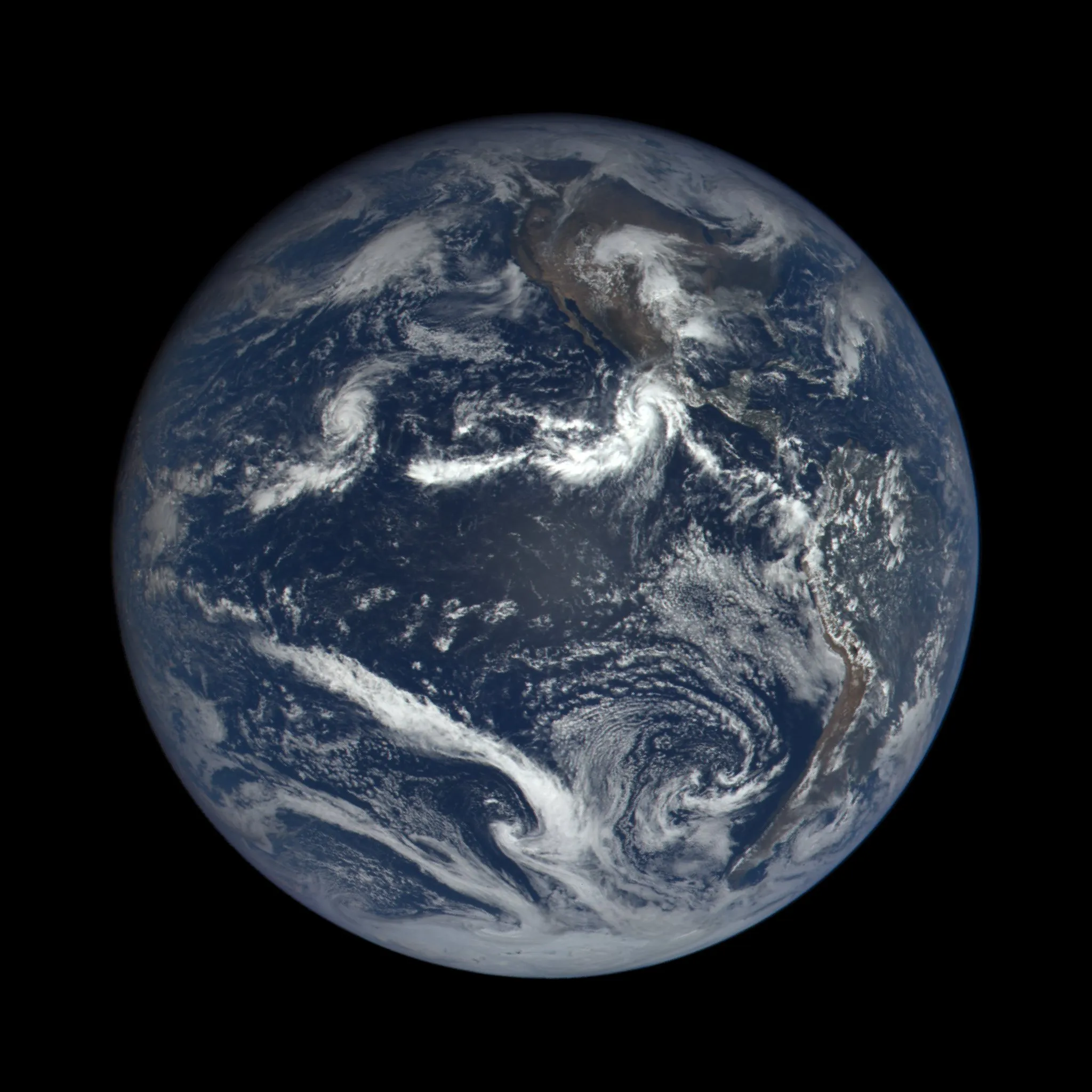
Seasons come from a tilt, not from distance.
Look
Guess first: in which month is Earth closest to the Sun?
In early January, in the middle of northern winter. So distance cannot be what makes summer.
Many people think summer happens when Earth is closer to the Sun. It is not true. Earth is closest to the Sun in early January, which is winter in Europe, North America and most of Asia.
The real reason is that Earth is tilted. Its spin axis leans by about 23.4 degrees. The axis keeps pointing the same way in space (towards the North Star) all year. So:
- In June, the northern half of Earth leans towards the Sun. Days are long, the Sun climbs high, and the north has summer. The south has winter.
- In December, it is the other way round.
- In March and September, neither half leans towards the Sun. Day and night are about equal everywhere. These are the equinoxes.
Try the Seasons Explorer above. Move the date and the latitude and watch two things change: how high the Sun gets at noon, and how many hours of daylight there are.
Understand
Two effects make summer warm:
- Height of the Sun. When the Sun is high, its light hits the ground more directly and each square metre gets more energy. When it is low, the same beam is spread over a bigger area.
- Length of the day. More hours of sunlight means more time to warm up and less night to cool down.
The Sun’s position north or south of the equator is called its declination. It swings between +23.44° (June solstice) and −23.44° (December solstice) and crosses 0° at the equinoxes.
At noon, the Sun’s height above the horizon is:
noon height = 90° − |latitude − declination|
For London (51.5° N) in June: 90 − |51.5 − 23.44| = 61.9°. In December: 90 − |51.5 + 23.44| = 15.1°. That is a huge difference in how strongly sunlight heats the ground.
Near the poles something stranger happens. North of the Arctic Circle (66.56° N) there is at least one day each year when the Sun never sets, and one when it never rises.
Master
The length of daylight comes from the hour angle H₀ of sunset, where the Sun’s centre meets a flat horizon:
cos H₀ = −tan φ · tan δ, daylight = 2H₀ / 15 hours
with latitude φ and declination δ, H₀ in degrees. If −tan φ · tan δ ≤ −1 the Sun never sets; if it is ≥ 1 it never rises. At the equator (φ = 0) the formula gives 12 hours on every day of the year.
This is the geometric day. Real daylight is longer by several minutes because the atmosphere bends light over the horizon (refraction, about 0.57°) and because sunrise is defined by the Sun’s top edge, not its centre (about 0.27°). Official sunrise tables use −0.833° instead of 0°.
The declination itself comes from the Sun’s ecliptic longitude λ and Earth’s obliquity ε: sin δ = sin ε · sin λ. The tool uses the U.S. Naval Observatory’s approximate formula for λ, accurate to about 0.01° this century.
The distance effect is real but small. Between perihelion (147.1 million km) and aphelion (152.1 million km) the sunlight reaching Earth changes by (152.1/147.1)² ≈ 1.069, about 7%. Tilt changes the noon sunlight per square metre at London by a factor of sin 61.9° / sin 15.1° ≈ 3.4, and the day length by a factor of more than two.
やってみろ
Set the latitude to where you live. Find the date of your longest day. Then drag the axial tilt slider to 0 degrees: what happens to the seasons? Try 90 degrees too, like Uranus.
Great. Challenges are where the learning sticks.
クイッククイズ
3 quick questions. Pick an answer to see if you are right.
-
What mainly causes Earth's seasons?
- A Earth is closer to the Sun in summer
- B The tilt of Earth's spin axis
- C The Moon
- D Changes in the Sun's brightness
Show the answer
B. The tilt of Earth's spin axis Earth is actually closest to the Sun in early January, during northern winter.
-
On the June solstice, which place has 24 hours of daylight?
- A The equator
- B London
- C The North Pole
- D The South Pole
Show the answer
C. The North Pole
-
At the equinoxes, how long is the day everywhere on Earth (ignoring air effects)?
- A 12 hours
- B 24 hours
- C It depends on the longitude
- D 0 hours
Show the answer
A. 12 hours
Finish line
- Played with the interactive
- Read the lesson
- Did the challenge
- Took the quiz
Mark the lesson complete to save it to your progress on this device.
Lesson complete. Well done!
Up next Moon phases and eclipsesこのレッスンの単語
ソース
- U.S. Naval Observatory: Approximate Solar Coordinates
- NASA NSSDCA Planetary Fact Sheet (obliquity, perihelion, aphelion)
- JPL SSD: astrodynamic parameters (obliquity of the ecliptic at J2000)
- NASA Space Place: What causes the seasons?
このレッスンはライセンス CC BY-SA 4.0 である。