
エネルギー凧:風力
Higher winds are stronger and steadier, and a kite needs no tower. Google's Makani spent thirteen years on the idea and published everything it learned. Here is what the physics promises, what flight tests actually measured, and what it would take to prove the rest.
Rschmehl / Wikimedia Commons (CC BY-SA 4.0)
現代の風力タービンを見ると、ほとんどが電力を生み出す部分ではない。 翼の塔と基礎と内半分は、速く動く翼先端を風に対して支えている。 先端は回転子の外部を約80m/sで掃き,そのところにエネルギーの大部分が捕獲される。 空中風力発電は簡単な質問をする:もし私たちが速く動く部分だけを保持して,それをテアに乗せて飛ばし,より強い風のある場所へ上昇させたらどうなるか?
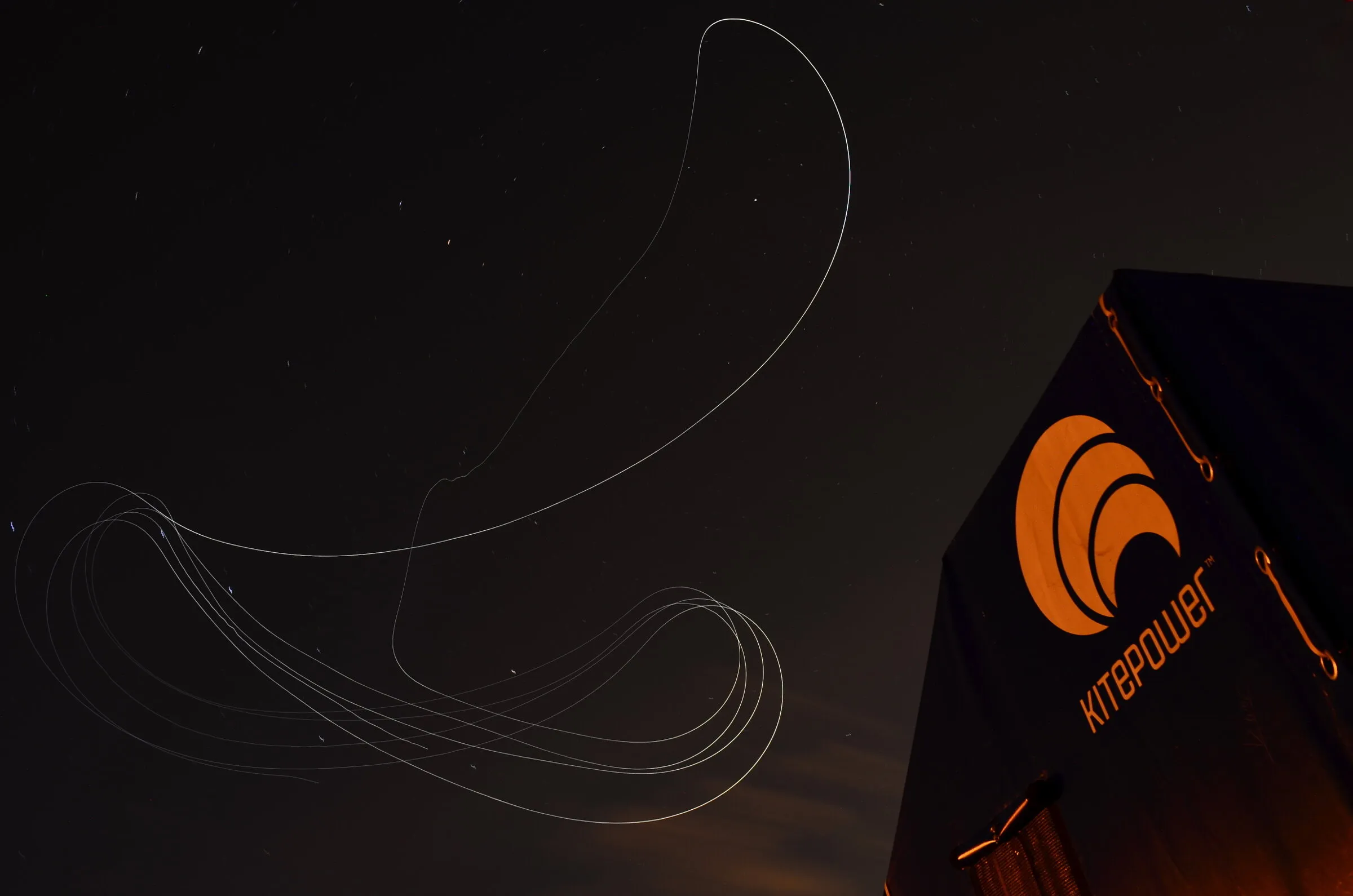
上の写真は光で描かれた答えである。 A tracing lamp on a Kitepower kite recorded one full cycle at night: tight figure-of-eight loops that pull the tether off a drum and turn a generator, then a long, calm return while the kite is winched back. This page explains how that works, what it has achieved, and why, after twenty years of serious effort, no airborne wind system has yet sold electricity at scale. **The short version: the physics is sound and the materials saving is real, but keeping a flying machine safe and working for twenty years, unattended, in all weather, is the unsolved problem. 商用ユニットからの独立測定出力を年間で公表した者はいない。
何だ?
An airborne wind energy system has three parts: a wing that flies, a tether that holds it, and a ground station. 主な家系は二つある。
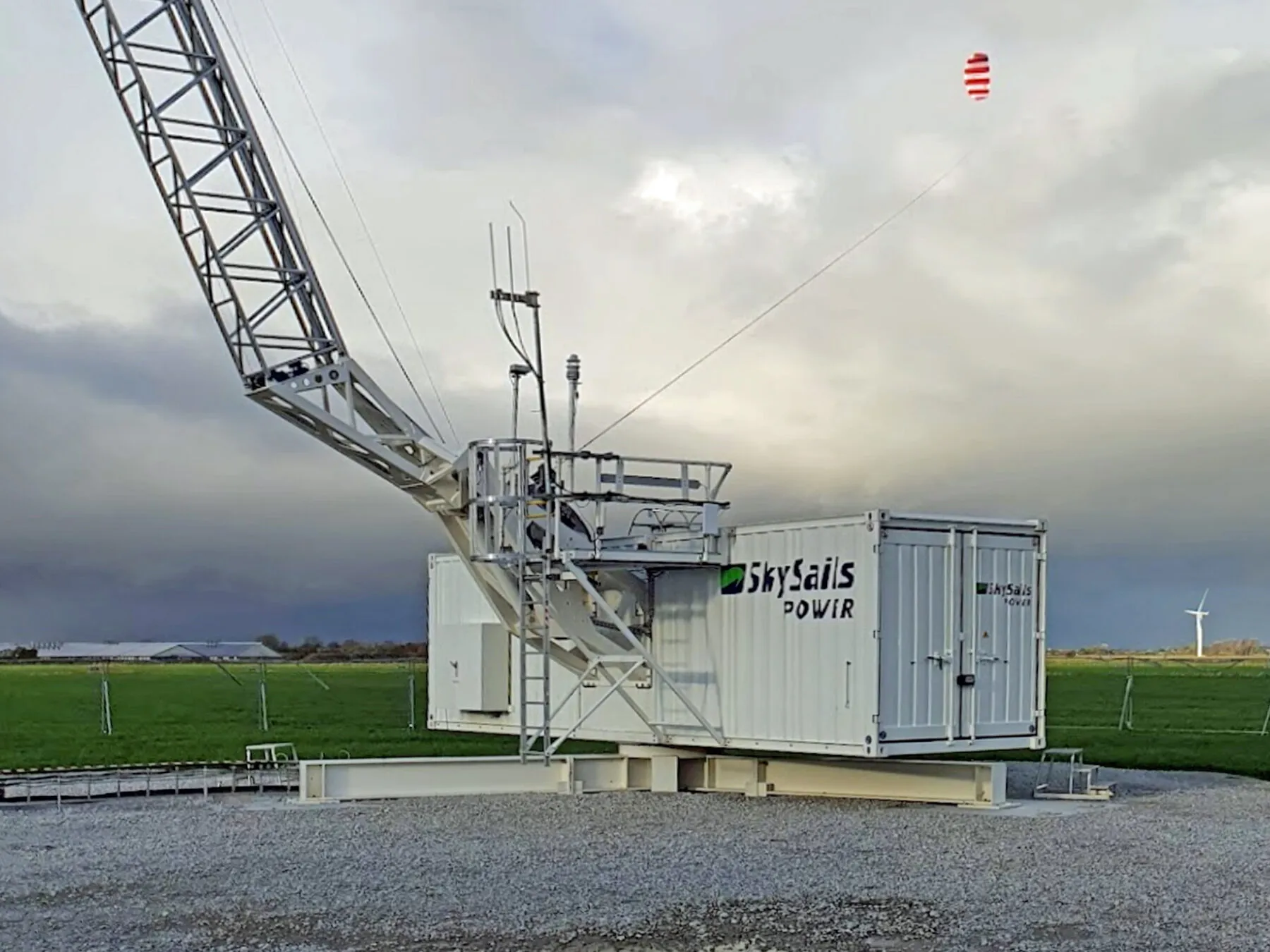
- 地上発生、「ポンピング」あるいは「ヨーヨー」の凧。 凧はテーターを強く引っ張る速い横風ループで飛ぶ。 地上にあるドラムからテザーが巻き上げられ,ドラムは発電機を駆動する。 テザーが十分に長くなったら、凧は引っ張りがほとんどない位置まで操舵され、ウインチで引き戻される。 また,この原理を用いたカイトの特徴と,その実現方法について述べた。
- 船上発電,「飛行タービン」。 剛体翼は小型ロータを搭載する。 横風飛行では,ロータがタービンとして働き,電気は導体テザーを下りて流れる。 離着陸時には,同じロータがプロペラとして働き,翼はドローンのようにホバリングする。 これはマカニの設計だった
両者とも翼はタービン翼先端の役割を果たす:風よりも速く風に沿って移動し,そこから力が生じる。
仕組み
The power in the wind. Wind carries power through each square metre facing it equal to ½ ρ v³, where ρ is the density of air (about 1.2 kg per cubic metre near the ground) and v is the wind speed. The cube matters: double the wind speed and the power goes up eight times. At 7 m/s a square metre carries about 210 W; at 10 m/s, about 610 W.
身長が高い。 地面近傍では,土壌や樹木,建物との摩擦が風を遅らせる。 一般的な技術規則は 高度と共に速度が増加するということです v = v_ref × (h / h_ref)^αここで指数は α 海上では0.10、農地では0.14、森林や町では0.25以上です 100mのハブで7m/sをとる。 At 400 m the rule gives 8.0 m/s over the sea, 8.5 over farmland and 9.9 over rough ground, so the power per square metre is 1.5, 1.8 and 2.8 times higher. 数百メートル上空では風はしばしば異なる振る舞いをし、夜には低いジェットが、昼には穏やかな層がある。 しかし,方向は明確であり,高度における風の安定化は収穫がない時間を減らすことも意味する。
なぜ凧が多くを捕まえるのか 1980年に技術者のマイルズ・ロイドは 風を通過する翼が どれだけのパワーを得られるか計算した1980年、ロード。). In plain language: a wing flying crosswind reaches a speed of about two thirds of the wind speed times its lift-to-drag ratio. With a lift-to-drag ratio of 5 in a 10 m/s wind, that is about 33 m/s, or 120 km/h; Kitepower quotes an average flight speed of 110 km/h for its kite (Kitepower). Because the aerodynamic force grows with the square of that speed, the wing can pull far harder than its size suggests. ロイドの極大は
P = (4/27) × ½ ρ v³ × A × C_L × (C_L / C_D)²
ここで Aは翼面積,C_Lはその揚力係数,C_L / C_Dはその揚力対抗力比である。 The factor after the wind power, (4/27) × C_L × (C_L/C_D)², says how many square metres of wind the wing effectively sweeps for each square metre of its own area. For a soft kite with a lift coefficient of 1 and a lift-to-drag ratio of 5 it is about 3.7. テザーの抵抗を含めたシステムの揚力対抗力比が9近傍の剛体翼では,10〜17となる。 A ground generator reaches this optimum when the tether reels out at one third of the wind speed.
ロイドが見逃した損失 実際の凧は地上局から直線的に下風を向いて飛ばされず,典型的には25〜35°の高度角で飛ぶ。 テザーに沿った風の一部だけが引っ張られ,その角度の余弦の三乗と共に出力は減少し,30°では65%しか残らない。 テザーは抵抗を加え,その長さと共に増大する。 100秒サイクルの80%は,130kWまで発電し,20%は,約20kWを引き出してカイトを引っ張る。カイトパワー). また,発電機,ギヤボックス,コンバータの損失,軽風で翼を飛ばすために消費される電力も考慮した。
なぜ テザーが全ての物語なのか タービンの塔は,その基部での曲げモーメントとして回転子の全推力を耐えなければならないので,塔と基礎が巨大である。 テザーは張力を担うだけで,超高分子量ポリエチレンのような繊維はその重さに対して非常に強い張力を持つ。 これは,同等の性能のタービンよりも90%まで材料を少なく使うという,いくつかの会社によって繰り返される主張の源である。 また,機械自体に対しては有効であるが,間隔,地上局の基礎,電力網接続を含む発電所全体に対しては未だ示されていない。
理論的・実用的限界
理論的に Loydの式は単一理想翼に対する天井である。 風車のように凧は風を減速させ、近くに飛ぶ凧は互いからエネルギーを吸収するので、農場にはスペースが必要である。 また,惑星限界もある。 ジェットストリームは高度10km付近で 広大な資源に見える ½ ρ v³ 地球システム分析によると ジェットストリームからの最大持続可能な抽出量は 7.5TWでした 以前の推定値よりも200倍少ない2011年、ミラーとガンスがクライドンを買収。). Nobody is proposing to fly at 10 km today; practical systems target 200 to 700 m. The global high-altitude resource from 500 to 12,000 m was mapped from 28 years of weather data by Archer and Caldeira (2009).
実用的だ プロジェクトを実際に停止させた限界は公式には含まれていません:
- 発射と着陸 タービンは離陸しない 凧は軽い風で起こし、激しい風で着陸し,損傷なしに年間数千回両方を行わなければならない。 Makani lost four airframes in flight, three of them while hovering, not while generating (Makani, 2020).
- どんな天候でもコントロールできる 風の強さ,風速,風向,風速の変化,風速の変化に対する風洞の応答を調べた。 テザーブレイクは、カイトや重いラインを危険な場所に置くべきではない。
- 空域と陸地 800mのテザーに400mでかいを巻くと,大きな体積を掃き出す。 航空当局はこれを受け入れなければならず、飛行エンベロープの下の土地は人や道路から遠ざけられなければならない。
- 着て ファブリックカイトは日光で劣化し,ドラムとプーリーのテザーが摩耗する。
- 大きさ Loydのパワーは翼面積と共に大きくなり,大きな翼は起飛・着陸が困難である。 Makani’s M600 had a 26 m wing (X); SkySails’ largest announced kite is 450 m² for a 450 kW unit. 5MWの航空機搭載システムは,現代の陸上タービンの大きさであり,まだ図面に過ぎない。
実際のプロジェクト、測定
実験結果は豊富で,長期データは少ない。 ここでチェックできるものは
| プロジェクト | デザイン | それが達成したことは | 何があったの? |
|---|---|---|---|
| マカニM600 (米国,Google X,2006年〜2020年) | 600kWの剛翼、8つのローター、440mの導電テザー | 28.9 h autonomous flight, 22.7 h crosswind; best loop 290 kW, best ten-minute average 196 kW in 10 to 13 m/s wind; first offshore flight from a floating platform in Norway, August 2019 | Closed February 2020: “the road to commercialization is longer and riskier than hoped”. The team’s own verdict: the M600 airframe “is fundamentally unable to generate 600 kW at 11 m/s”. Reports, code and flight logs released in September 2020 |
| スカイセイルズ・パワー (ドイツ) | Soft kites up to 180 m² on a ground winch; up to 200 kW cycle power (PN-14, now sold as Venyo) | Prototype at Klixbüll operating since 2019 with kites up to 120 m², the longest record of any airborne system; a 120 m² kite flying 200 to 400 m up on an 800 m maximum tether in Mauritius from January 2023; first flight in Taiwan on 1 July 2025 | Selling units; the company quotes up to 760 MWh a year per unit at good sites, a manufacturer figure, not an independent measurement. A 450 kW model (KYO) is announced with first deliveries expected in the second half of 2028 |
| カイトパワー (オランダ,デルフト工科大学) | 100平方メートルのソフトカイト、350メートルのテザー、6メートルのコンテナに入った地上発電機 | 回転中の出力は130kWまで,サイクル当たり約100秒;オランダの建設現場でのパイロット実験,アイルランドのベラコリックとRWE,アルバ | ディーゼル発電機の代替など移動型、一時的なゼロエミッション電力として市場化 |
| 風車 (ノルウェー) | 地上ウィンチ式固定グライダー | ヴァンセ、リスタの試験場で350m以上飛行 | 開発は継続中であるが、公開された長期的な出力データはない。 |
| アンピックス・パワー (オランダ,2008年〜2022年) | 地上ウィンチに固定した自律滑空機、2012年初の完全自律発電 | AP-3までの開発試作機 | Suspension of payments 19 April 2022, declared bankrupt 4 May 2022 after a planned funding round did not happen |
出典: マカニ エネルギーの凧2020; X, マカニ; スカイセイルズ・パワー; カイトパワー; 風車; アンピックス・パワー.
注目すべき二つの事実がある。 First, Makani’s best ten-minute average was a third of its rated power, and only about one loop in five produced net energy, most of the others being test manoeuvres, light winds and hovering. Second, the most mature systems today are ground-generation soft kites of 100 to 200 kW, more than ten times smaller than a typical onshore turbine, sold for places where a turbine is hard to build: islands, remote sites, temporary power. A review of two decades of flight testing reaches the same balanced view: control has made striking progress, and long-duration, fully autonomous operation remains the frontier (Vermillion et al., 2021).
どれだけかかる?
空中風力発電の市場価格はまだないが,予測値であるため,この数字には注意を払う必要がある。
| オプション | Cost per kWh | 番号の状態 |
|---|---|---|
| 新しい陸上風力発電所,無補助金 | $0.027 to $0.073 | 市場データ ラザードLCOE+ 2024 |
| 新しい海上風力発電所 | $0.074 to $0.139 | 市場データ、ラザード2024 |
| ガスピーキングプラント | $0.110 to $0.228 | 市場データ、ラザード2024 |
| 建物の屋根にソーラーパネルを設置し | 0.19ドル | Our Fan Wall model; commercial rooftop $0.09 to $0.20 in Lazard, 2026 |
| スカイセイルス京都450kWターゲット | 10セント以下で | メーカ目標、まだ発売されていない |
| マカニM600 | 未公開 | また,このシステムが従来のタービンと競争できるLCOEに達するかどうかは「不明瞭」であると述べた。 |
航空機の風速は 必ず答えなければならない 陸上風力発電所の場合,タービン自体はエネルギーコストの半分以下であり,道路,基礎,ケーブル,電網接続,設置,運転および資金が残りを占める。 Offshore, these “balance of system” costs are about 52% of the total (Makani, 2020). 従って,塔鋼の90%を節約しても電気料金は90%下がらない。 To beat onshore wind at $0.03 to $0.07, a kite must also match a turbine’s high availability, its 25-year design life and its low maintenance. Against our building benchmark of $0.19 per kWh the bar is lower, but kites do not fit on buildings: they need hundreds of metres of clear land or sea.
勝てる場所と 負けられる場所
勝ち取れるものは
- 遠隔・島式電力網 輸入ディーゼルで動くものです 本土の電気価格の数倍になります タービンは運搬し設置が難しいので コンテナ化された地上局を簡単に作れるのです
- 暫定的な権力建設現場,災害救助,軍事・研究キャンプ,数か月間タービンが作動できないイベントなどでの利用例を紹介した。
- 深海沖合軽量の浮遊式地上局は 浮動式タービンよりも安価になる これはノルウェーでマカニとシェルが試験した賞であり,まだ証明されていない。
- 上空で強風が吹き、ハブ高度では弱い風のある場所例えば、凧の高さが最も重要な地形での飛行において
勝てない
- 都市や建物に 飛行エンベロープは数百メートルの幅がある。
- 良好な場所における沿岸風に対する今日は タービンは成熟し,銀行に貸付可能で安価である。
- 空港や繁忙な空域の近く飛行経路の下にある土地を 確保できない場合
証明されたもの、可能性のあるもの、推測的なもの
Proven: the power law of crosswind flight (Loyd, 1980), confirmed in many flight tests; that tethered wings can generate electricity autonomously for hours, with pumping cycles and with onboard rotors; that the M600 produced a best ten-minute average of 196 kW; that ground-generation soft kites of 100 to 200 kW can be launched, flown and landed from a container-sized station; that wind speeds and power densities rise with height on average.
可能性: 数百キロワットの地上発電システムは遠隔地で高い利用可能性を持つことができる kWあたりの材料使用量はタービンよりもずっと低い 海上浮遊する凧には ずっと軽いプラットフォームが必要になる
Speculative: a cost per kWh competitive with onshore wind; megawatt-scale kites; farms of many kites flying close together without interfering; twenty-year lifetimes for kites, tethers and drums; insurance and certification frameworks comparable to those for turbines.
開放的な研究課題
- どれだけ信頼できるか 完全に自律的な発着機を 何千回も測定されたのです
- What is the real annual energy yield of a unit at a known site, measured independently for a full year, and how does it compare with a turbine next to it?
- どれくらいかかる? テザーや布製の凧 どのようにして破損前に摩耗が検出されるのか?
- 凧はどれくらい近づけるか 農場の中にどれだけの損失をもたらすのでしょうか?
- 何だ 空域規則 どうやって凧を照らし 航空機に検出されるべきか?
- 凧は何をするのか 鳥やコウモリ? 実際のデータはほとんどなく,遅いソフトカイトと速いハードウィングに対しては答えが異なる。
- 缶 海上に浮かぶ地上基地を 風船を打ち破るコストで嵐を乗り越えるのか?
実用的なプロトタイプには
また,小規模チームのために良いニュースは,ポンプカイトが適度な規模でテストできることであり,物理学は翼面積と共に予測可能な方法で拡大する。
| 位相 | ワーク | それが可能にする決定 | 粗費 | タイム |
|---|---|---|---|---|
| 0. Desk study | 標的地点のロイドとサイクルモデル,オープンツールとMakaniの公開コードを用いて;ライダキャンペーンまたは再分析から100〜500mの風データ | 風は高いところで それに値するのか? | $10k to $30k | 2~3ヶ月 |
| 1. Force test | A 10 to 20 m² kite on a load-cell-instrumented tether and winch, flown manually then with autopilot | テザー力とパワー曲線をLoydに対して測定した。 | $30k to $80k | 6ヶ月 |
| 2.作動モデル | 10〜30kWの地上局:ドラム、モーター発電機、パワーエレクトロニクス、オートパイロット;各サイクルに対してログイン・アウトエネルギー | Net measured kWh per day and automatic cycles without a pilot | $150k to $400k | 12ヶ月 |
| パイロット3 | 100kW級の遠隔地あるいは一時的な場所に設置され,野生生物モニタリングを含む全年間計測出力と利用可能性を有する。 | Real annual yield, cost per kWh, maintenance | $1M to $3M | 18から24ヶ月 |
A working model, for this page, means phase 2: a ground station that runs complete pumping cycles and puts metered net energy into a battery or the grid, with every cycle logged. 縄を強く引く凧はまだ発電所ではない。
誰が必要なのか
- 航空管制技術者 自律飛行するドローンや凧の経験を持つ人が 離陸、着陸、故障処理などの大半の作業をします
- 空力学者 テザードラグや柔軟な構造を含む 凧とウイングの設計に使われています
- パワーエレクトロニクス・ドライブ技術者 ウィンチモーター発電機のための リールイン相のエネルギー貯蔵と グリッド接続です
- 材料工学者 テザーや布地の疲労試験に使われています
- 気象学者 50mから600mの風を測定するライダー技術を持っています
- 航空規制専門家 飛行許可と空域予約を確保するためです
- 生態学者 鳥やコウモリのモニタリングを設計しました
- ホストサイト島や遠隔地、採石場、開けた土地と支援的な隣人を持つ大規模農場などです
もっといい考えは?
財団のメンバーの中には 強力なエネルギーアイデアを 聞くことができる人がいるかもしれない アイデアをピッチするには 実際に電力を生み出す出力は,主張しない計測器で測定した。 また,エネルギーカイトの場合は,自力でポンプサイクルを完了し,そのエネルギーをログする地上局を意味する。 論文のアイデアも歓迎する。物理学と数値が確実なら、ここでウェブサイトに公開できる。 しかし,実用的なモデルがないと資金調達は非常に困難であり,ここでは資金調達やリターン,導入の約束など何もない。
あなたのアイデアや飛行データを 寄付書類また,実験結果を基に,問題解決のための最適な試験法を提案した。 その他の方向は、 代替エネルギーを比較してみると 私たちのオープンソースプロジェクトは ファンウォール研究.
ソース
- ロイド (1980). 横風カイト発電(大規模風力発電用)。 電力学会誌,4(3),106‐111.
- Makani Technologies (September 2020). エネルギーの凧また,M600の性能低下,FCW‐01の海上飛行,エネルギーコスト解析についても述べた。 パーツ 二 それに 第三.
- X 月着陸機工場 マカニM600,エネルギーカイトコレクション,2020年閉鎖。
- Vermillion,C.,Cobb,M.,Fagiano,L.,Leuthold,R.らの研究結果を紹介した。 (2021). Electricity in the air: insights from two decades of advanced control research and experimental flight testing of airborne wind energy systems. 年次レビュー,コントロール52,330-357.
- Cherubini,A.,Papini,A.,Vertechy,R.,Fontana,M. (2015). 航空機搭載風力発電システム:技術のレビュー。 再生可能エネルギーと持続可能なエネルギーレビュー51,1461-1476.
- Archer,C.L.とCaldeira,K. (2009). 高地風力発電の世界的評価。 エネルギー2(2),307-319.
- Miller,L.M.,Gans,F.,Kleidon,A. (2011). ジェットストリーム風力は,再生可能エネルギー資源としての小電力で大きな影響をもたらす。 Earth System Dynamics 2, 201-212.
- スカイセイルズパワー News, including SkyPower100 at Klixbüll (2022), Mauritius (2023) and Taiwan (2025); Venyo (PN-14) data.
- 風船の力 ファルコン・システムの技術データ.
- ケイミル 会社サイト.
- アンピックスパワー: 2022年の会社経歴と破産.
- Lazard (June 2024). Levelized Cost of Energy+, version 17: onshore wind $27 to $73 per MWh, offshore wind $74 to $139, gas peaking $110 to $228. The June 2026 edition gives the commercial rooftop solar range used as our benchmark.
- Local Solar System ファウンデーション The Fan Wall: open wind research, for the rooftop solar benchmark of $0.19 per kWh.