
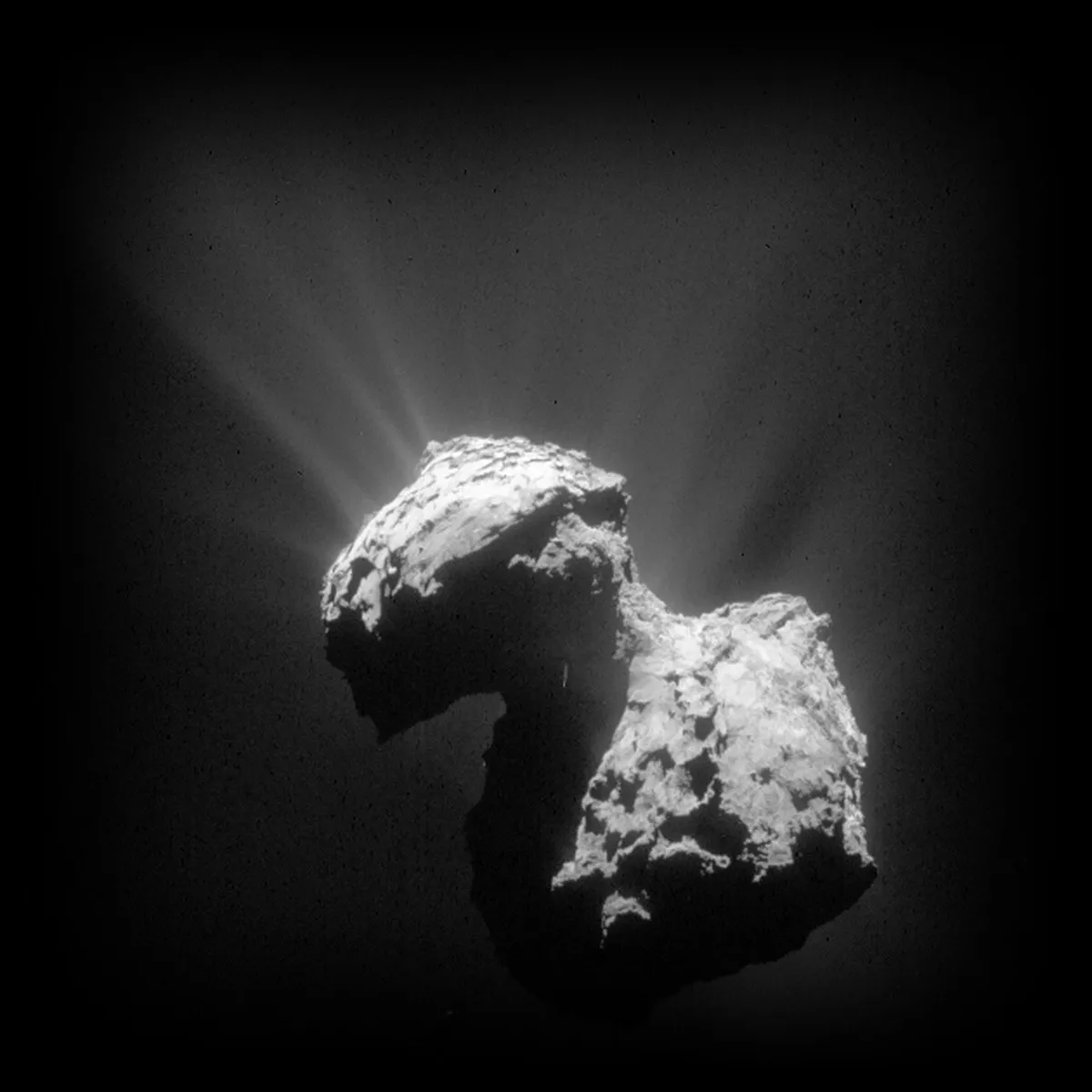
67P/Churyumov-Gerasimenko
67P/Churyumov-Gerasimenko is a 4 km two-lobed comet that circles the Sun every 6.4 years. ESA's Rosetta orbited it and Philae landed on it in 2014.
ESA/Rosetta/NAVCAM (CC BY-SA 3.0 IGO)
A two-lobed chunk of ice and dust, shaped like a rubber duck, and the first comet a spacecraft ever orbited and landed on.
Comet 67P/Churyumov-Gerasimenko is a small Jupiter-family comet that loops between the orbits of Mars and Jupiter every 6.4 years. From 2014 to 2016 the European Space Agency’s Rosetta spacecraft flew alongside it, and the Philae lander touched down on its surface in November 2014. No comet has been studied as closely.
How big is comet 67P?
67P is made of two lobes joined by a narrow neck, which is why it is often compared to a rubber duck. ESA measured the larger lobe at about 4.1 by 3.3 by 1.8 km and the smaller one at about 2.6 by 2.3 by 1.8 km. The whole nucleus is about 4 km long, roughly the width of Manhattan.
Its mass is about 1.0 × 10¹³ kg (10 billion tonnes). Its density is only about 0.53 g/cm³, around half that of water, so the comet would float if you could find a big enough bath. That means it is very porous: perhaps 70 to 75% of its volume is empty space between loosely bound grains of dust and ice.
Scientists think the two lobes formed separately and later touched gently, at walking pace, rather than being carved from one body. Layers in each lobe point in different directions, which supports this.
Where does 67P orbit?
67P follows an elongated orbit (e ≈ 0.64) with an average distance of about 3.46 au from the Sun. At perihelion it comes to about 1.24 au, just outside Earth’s orbit, and at aphelion it reaches about 5.7 au, near Jupiter’s orbit. One orbit takes about 6.4 years.
Its path has changed a lot. Until the mid-1800s it never came closer to the Sun than about 4 au, too far for it to grow a tail. A close pass by Jupiter in 1840 pulled it inward, and another in 1959 set its present orbit. Comets like this are thought to come from the Kuiper belt, nudged inward by collisions and planetary tugs. See gravity assists for how a planet can reshape an orbit.
How long is a day on 67P?
When Rosetta arrived, 67P rotated once every 12.4 hours. Jets of gas acting like small thrusters sped it up during the 2015 perihelion, to about 12.1 hours. The rotation was slower still, about 12.76 hours, before 2009.
What is comet 67P made of?
The nucleus is a dark mix of dust, rock and ices, reflecting only about 6% of the light that falls on it. Water ice, carbon dioxide and carbon monoxide are the main ices. As the comet nears the Sun, these ices turn to gas, dragging dust with them to form the coma and tail. NASA notes that 67P sheds about twice as much dust as gas.
Rosetta found a surprising landscape: cliffs, pits hundreds of metres deep, smooth dusty plains and boulders the size of houses. As Rosetta approached in July 2014, the surface measured about -70 °C to -40 °C, warmer than expected because the dark dust absorbs sunlight while the ice lies beneath.
What did Rosetta discover?
- Water vapour with about three times the ratio of heavy hydrogen (deuterium) to normal hydrogen found in Earth’s oceans, suggesting that comets like 67P were not the main source of Earth’s water.
- Molecular oxygen and molecular nitrogen, detected at a comet for the first time.
- The amino acid glycine and the element phosphorus, both building blocks used by life.
- Exposed water ice on the surface, and seasonal cycles of frost.
How did Rosetta and Philae explore 67P?
Rosetta launched on 2 March 2004 on an Ariane 5 rocket. It needed a decade to reach the comet, using three flybys of Earth and one of Mars to gain speed, and passing the asteroids Šteins (2008) and Lutetia (2010) on the way. It then slept for 31 months to save power before waking on 20 January 2014. NASA provided several of its instruments. Read about this kind of route in Hohmann transfers and rendezvous.
Rosetta reached 67P on 6 August 2014. On 12 November 2014 it released Philae, which made the first landing on a comet. Its harpoons failed to fire, so it bounced twice and came to rest in shadow beside a cliff, at a site later named Abydos. Philae sent back about 60 hours of data before its batteries ran out, then briefly called home in June and July 2015. Rosetta’s camera finally spotted it wedged in a crack in September 2016.
Rosetta followed the comet through perihelion on 13 August 2015. On 30 September 2016 it ended the mission by descending slowly onto the surface, taking images until contact.
Who discovered 67P, and can you see it?
Klim Churyumov discovered the comet in October 1969 while examining a photographic plate taken on 11 September 1969 by Svetlana Gerasimenko at the Alma-Ata Observatory, in what is now Kazakhstan. The “67P” means it was the 67th periodic comet identified.
67P is never a naked-eye comet. During its 2021 return it came within about 0.42 au of Earth and reached around magnitude 9, bright enough for a small telescope or large binoculars under a dark sky. Its next perihelion is due in 2028. Check a comet ephemeris for its position, and the night sky guide for observing tips.
Data sources
Tools and lessons use simplified models for learning only. They must not be used for navigation, mission planning or any operational decision. Certificates are free and non-accredited. Read the educational content disclaimer