
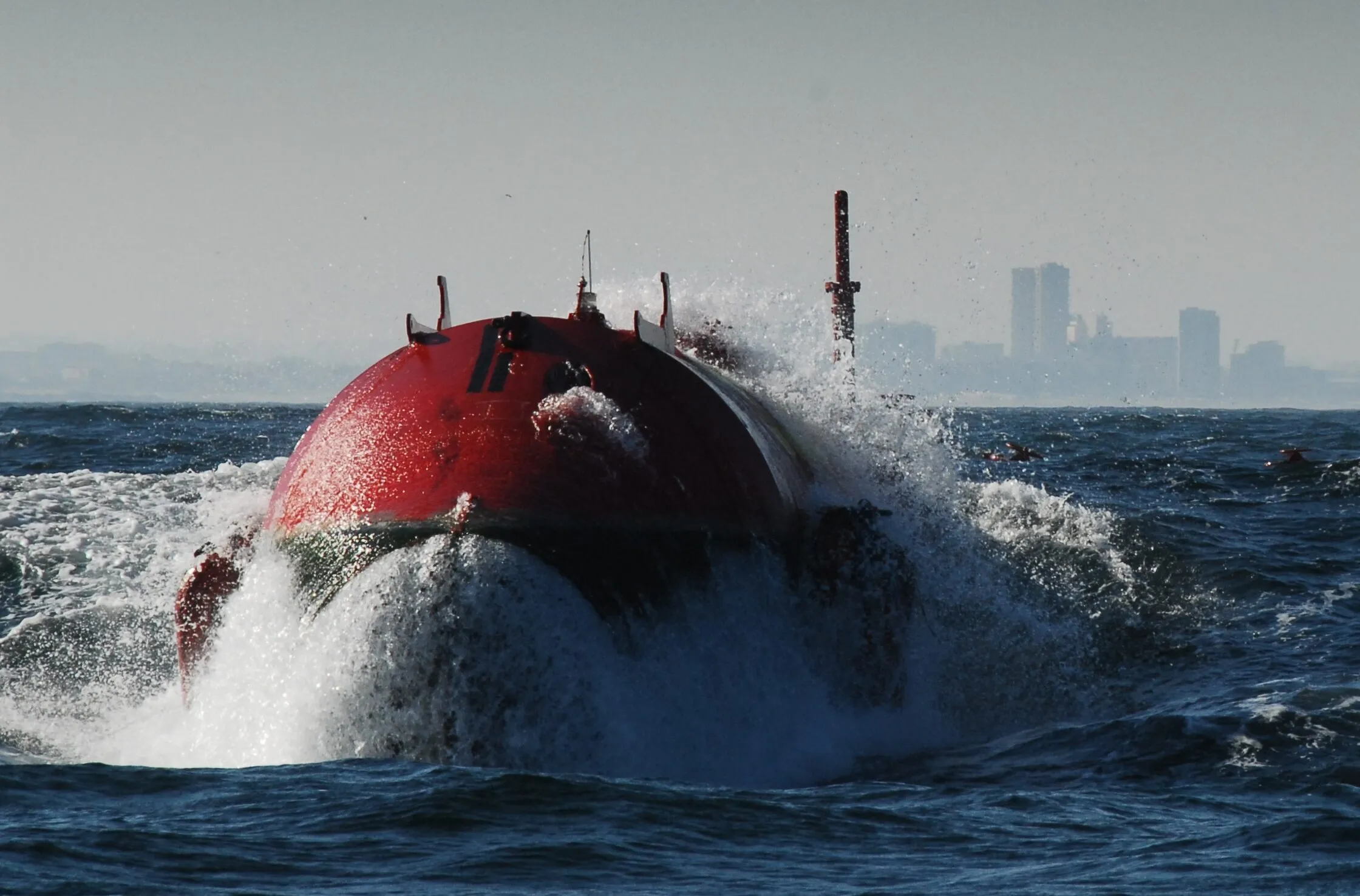
Wave energy
Waves are wind energy that the ocean has collected and carried for thousands of kilometres. There is a great deal of it, and it keeps coming at night and in winter. After fifty years of trying, nobody has yet built a wave machine that is both tough and cheap.
P123, via Wikimedia Commons
Stand on a west-facing coast in winter and you can feel it through your feet: every few seconds, a wall of water that has travelled across an ocean arrives and breaks. Waves are made by wind blowing over thousands of kilometres of open sea, so they are a concentrated, delayed form of wind energy. They keep arriving after the wind has dropped, at night as well as by day, and most strongly in winter, exactly when solar panels make least.
That is the promise, and it is real. This page, written with the same honesty as our Fan Wall research, is about why the promise has been so hard to keep. The short version: the physics works and the resource is large, but a wave machine must harvest ordinary seas while surviving storms that carry fifty times more power. After half a century and many failed companies, wave energy remains several times more expensive than solar, with no winning design yet. It can win first where power is expensive and the sea is the only neighbour.
What it is
A wave energy converter is any machine that turns the motion of waves into electricity. Unlike wind, where one design (the three-bladed turbine) has won, wave energy still has hundreds of competing ideas. They fall into a few families:
- Point absorbers: buoys that bob up and down and pull against an anchor or a heavy float. CorPower’s C4 is one.
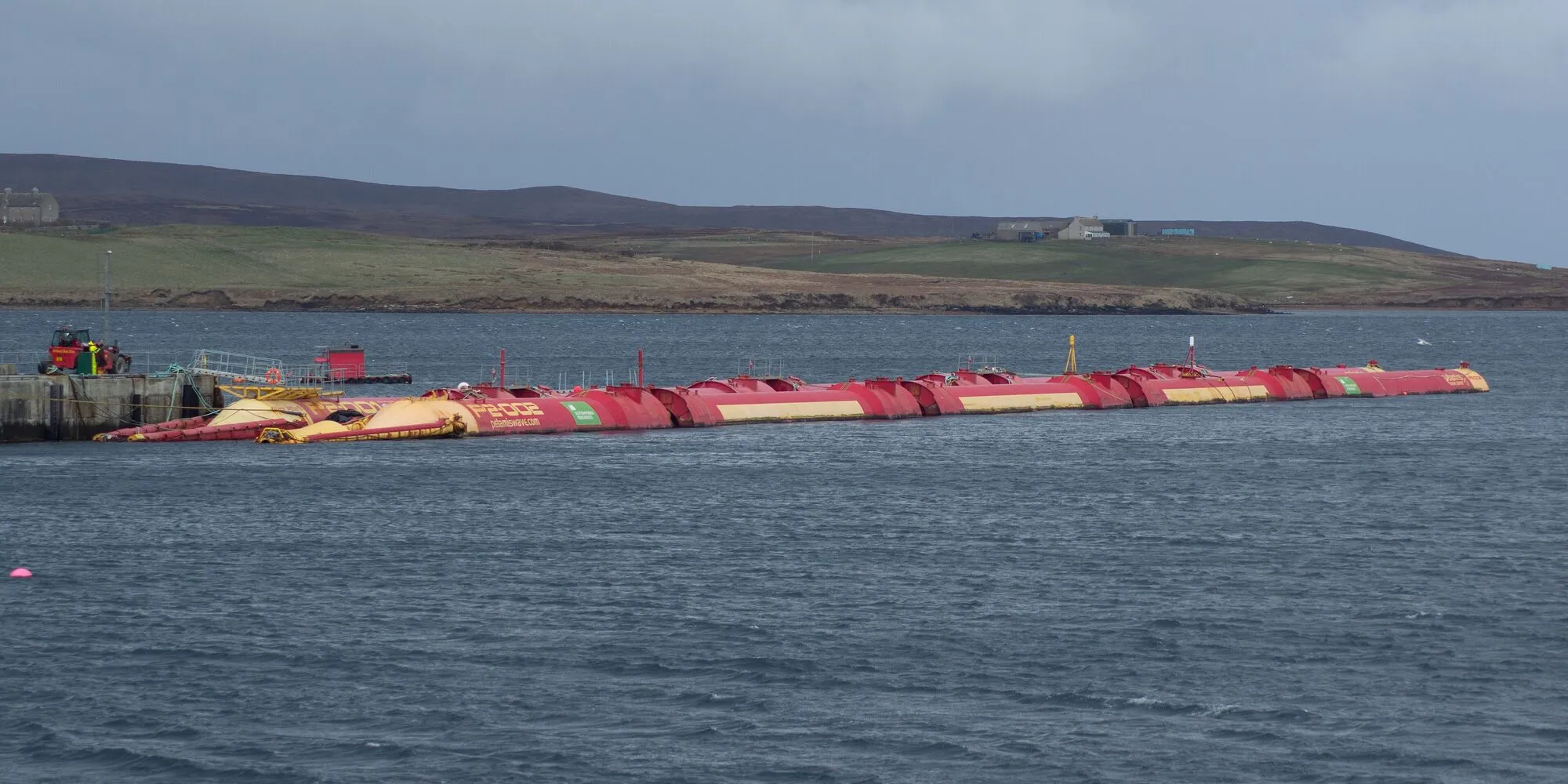
- Attenuators: long, snake-like chains of floats lying along the direction of the waves, bending at the joints. Pelamis was the famous example.
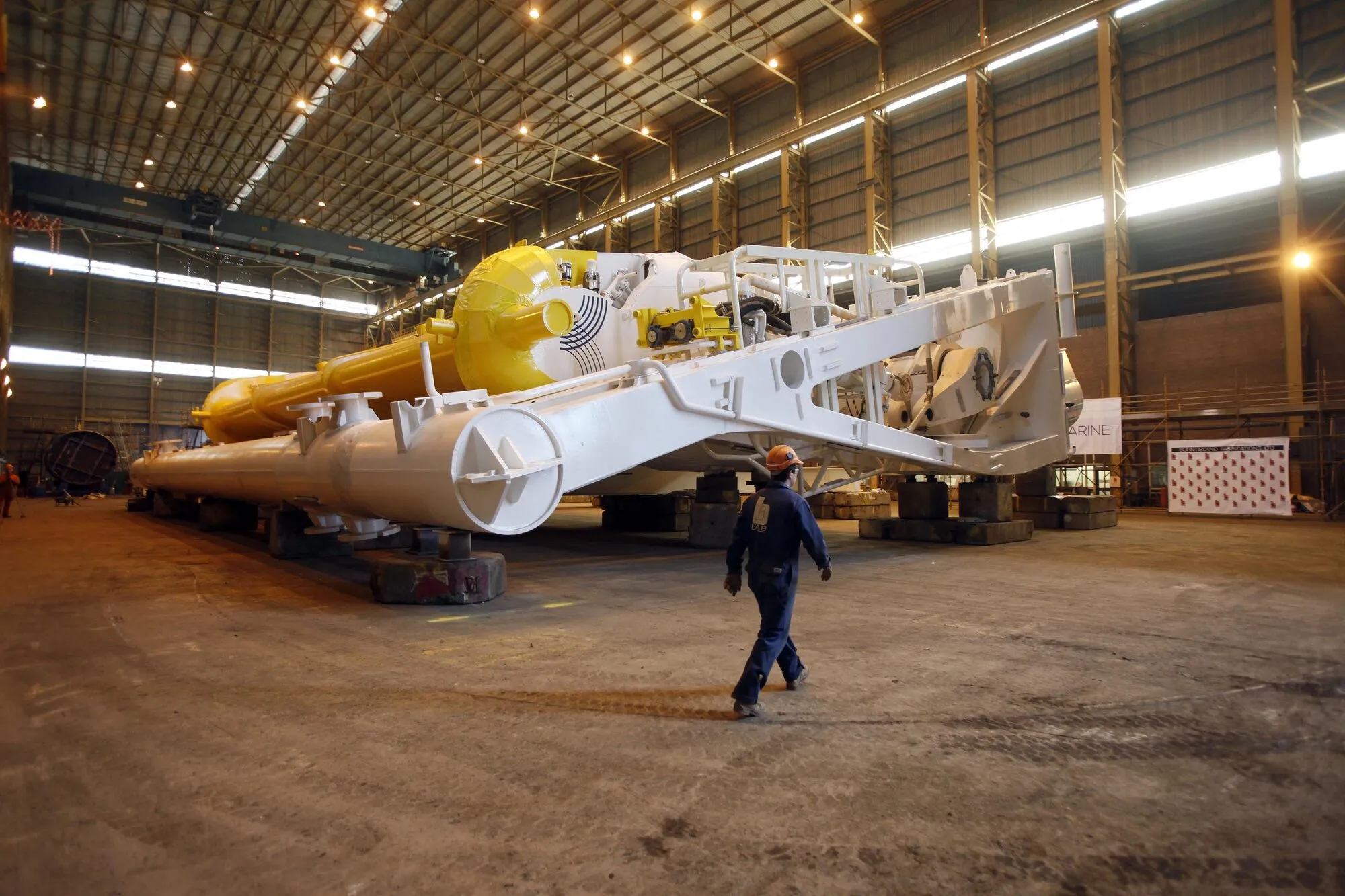
- Oscillating wave surge converters: hinged flaps on the seabed near shore that rock back and forth. Aquamarine Power’s Oyster was one.
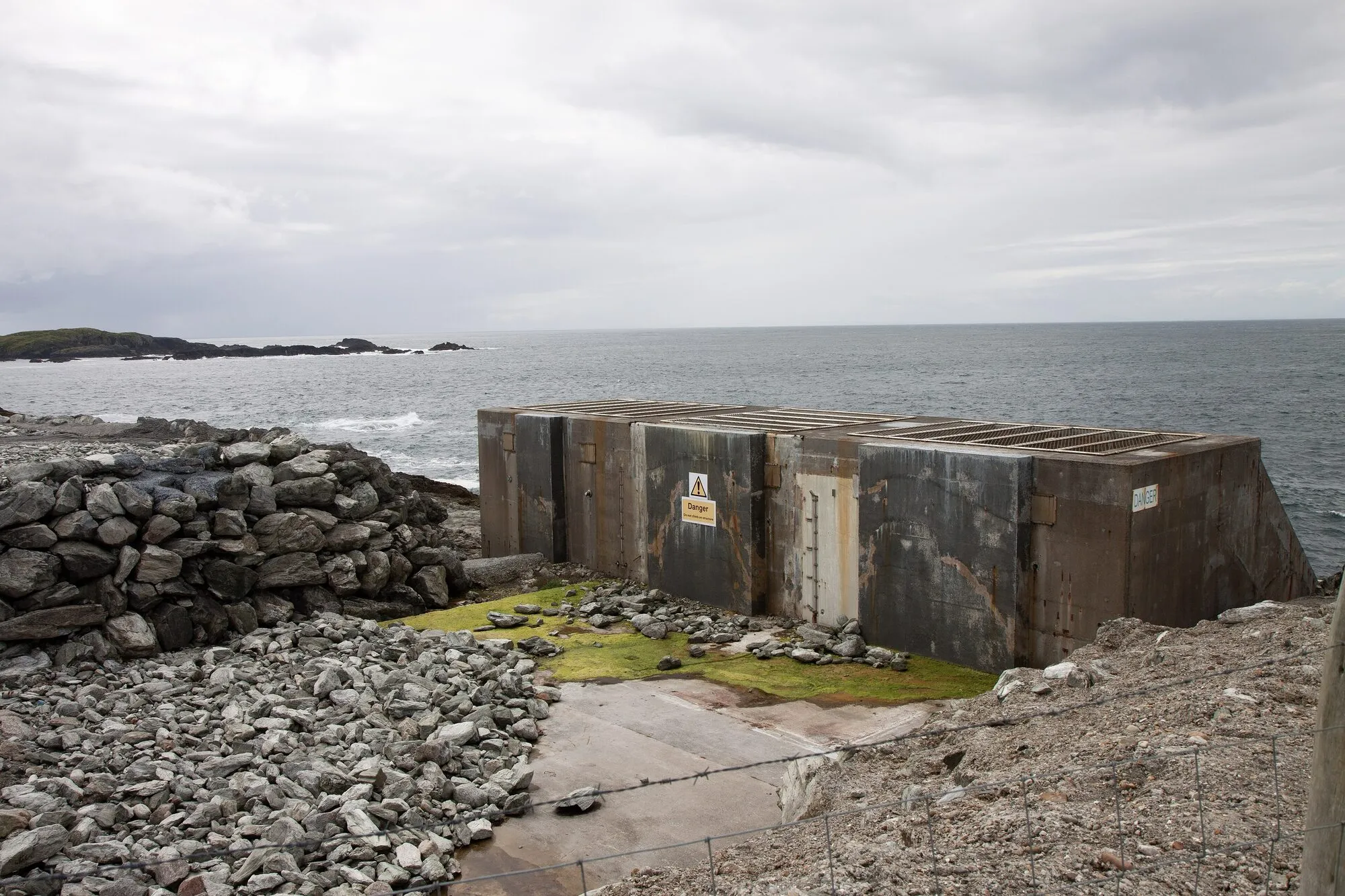
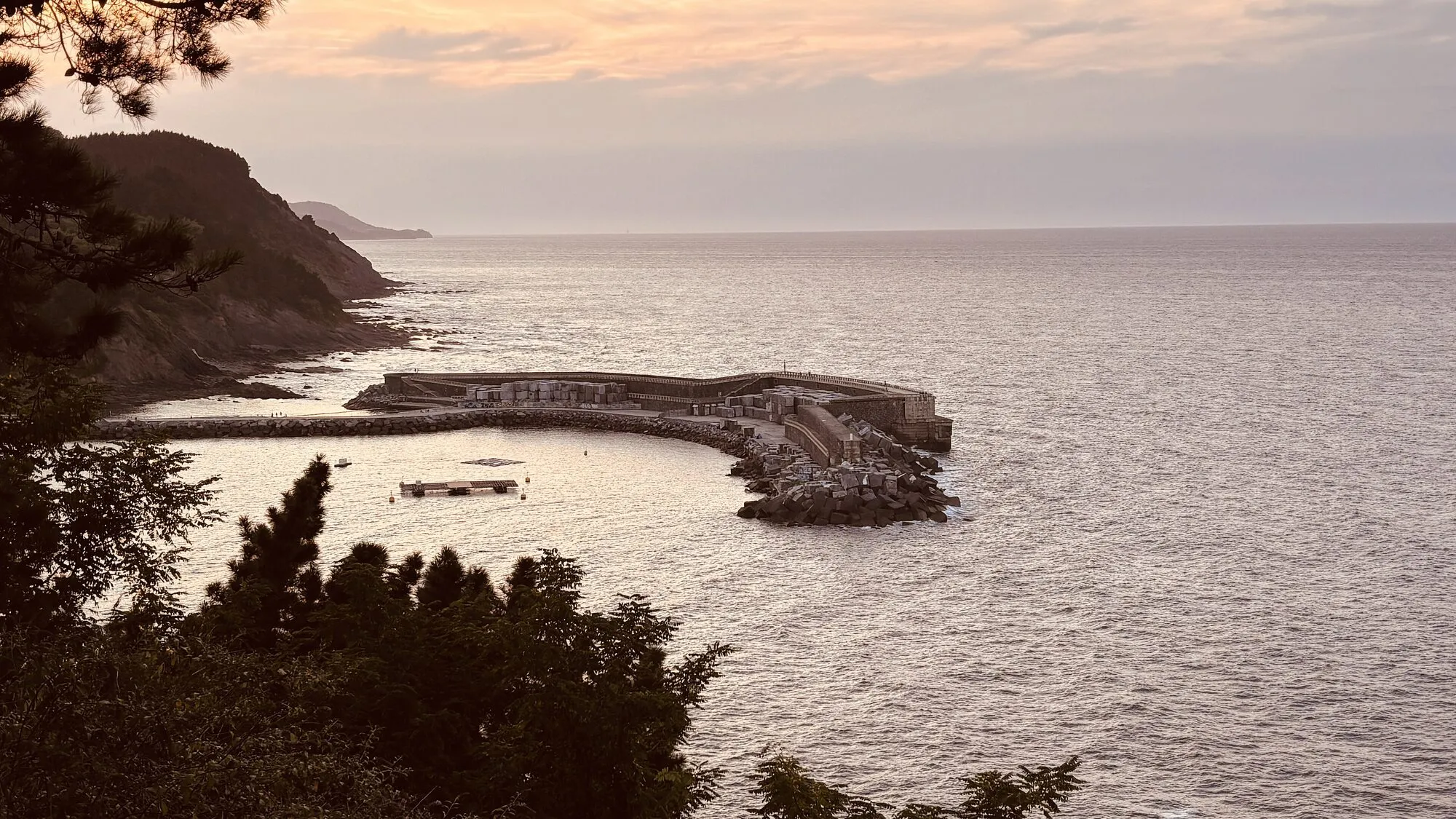
- Oscillating water columns: chambers open to the sea below the waterline. Waves push the water inside up and down, which pushes air in and out through a turbine. Mutriku in Spain has sixteen of them built into a harbour wall.
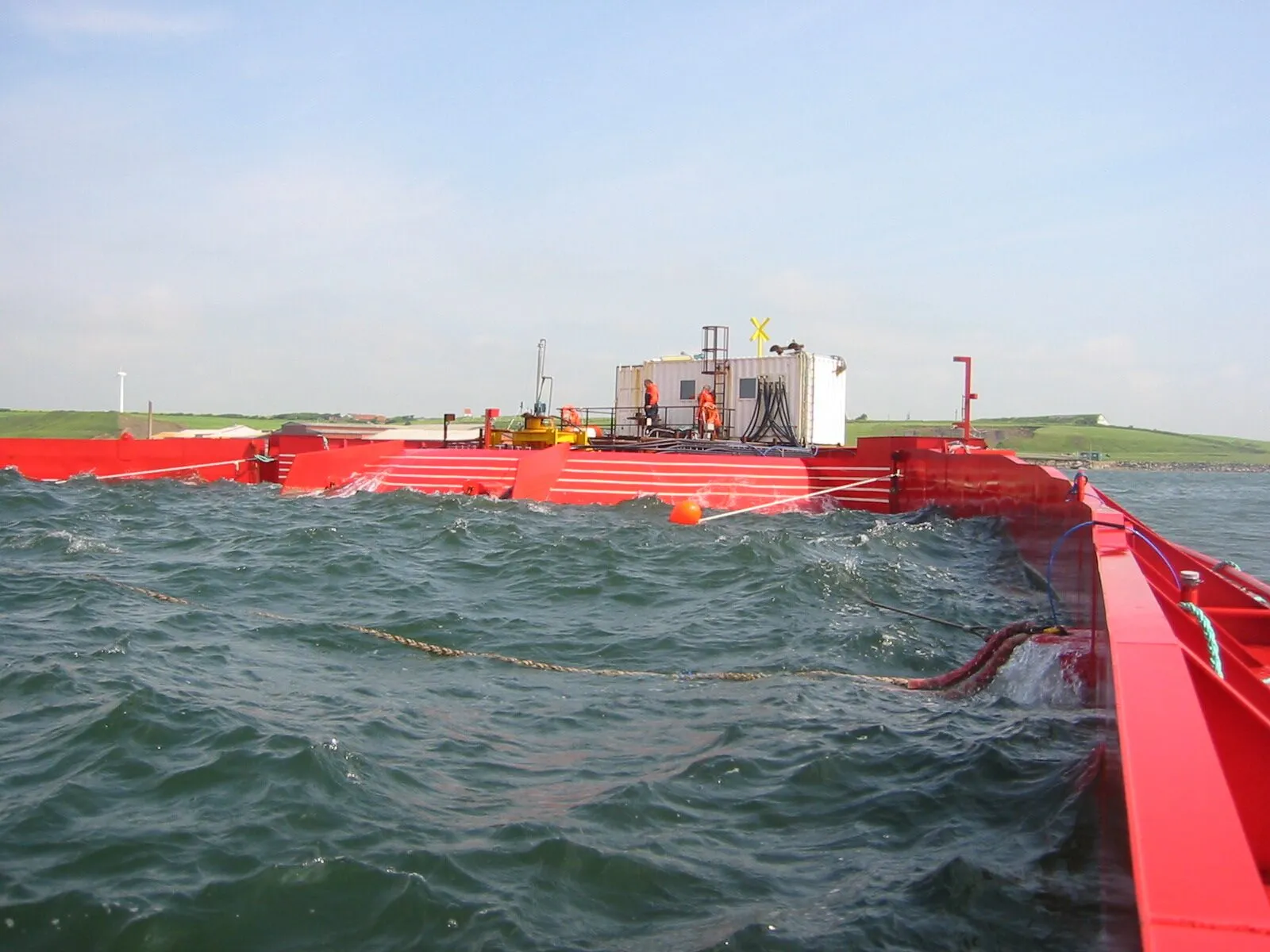
- Overtopping devices: ramps that let waves spill into a raised basin, then drain the water back through low-head turbines.
How it works
Energy in a wave. A wave’s energy is stored partly as water lifted above the average sea level and partly as the water’s motion. For an irregular sea described by its significant wave height H (roughly the average height of the highest third of the waves), the energy per square metre of sea surface is E = ρ g H² / 16, where ρ is the density of seawater and g gravity. Doubling the wave height quadruples the energy.
Power, the number that matters. Wave energy travels, at the group speed g T / 4π in deep water, where T is the wave period. Multiply energy by speed and the power arriving along each metre of wave front is P = ρ g² H² T / 64π, which works out as about 0.49 × H² × T kilowatts per metre. A 2.5 m sea with a 9 s period carries about 28 kW past every metre of coast: over a year, the electricity of dozens of homes per metre, if all of it could be caught. The explainer above lets you try other seas.
What the water does. In deep water, the water in a wave does not travel with it: each particle moves in a circle and returns almost to where it started. The circles shrink quickly with depth; half a wavelength down, the motion is only about 4% of that at the surface. Deep-water waves are long: the wavelength is about 1.56 × T² metres, so a 9 s wave is 126 m from crest to crest. That is why most wave energy is near the surface and why machines float or sit in shallow water.
To absorb a wave, make a wave. A wave machine takes energy by moving in a way that cancels part of the incoming wave. For a floating buoy that only moves up and down, this sets a famous limit: however large it is, it cannot capture more than the power arriving across a width of λ / 2π, one wavelength divided by 2π, about 20 m for a 9 s wave (Falnes, 2002). Reaching even that needs the buoy’s motion to stay in step with the waves, which is why control systems that tune a machine to each passing wave matter so much. In practice, measured and modelled machines capture typically between a tenth and a third of the power arriving across their own width (Babarit, 2015).
Slow, huge forces. A wave pushes with enormous force but moves slowly, a metre or two every few seconds. Generators prefer fast, gentle motion, so every wave machine needs a power take-off that converts one into the other: hydraulic rams and motors, air turbines, direct-drive linear generators or mechanical gearboxes. Much of the engineering, and much of the failure, happens here.
The limits: theoretical and practical
The resource. Averaged over the planet, about 2.1 TW of wave power reaches the world’s coastlines, of the same order as the world’s average electricity use of about 3.4 TW (Gunn and Stock-Williams, 2012). Only a fraction can be taken: machines cannot line every coast, energy is lost as waves reach shallow water, and much of the resource is in remote southern oceans. The richest coasts face the prevailing westerly winds between about 40 and 60 degrees of latitude: Ireland, Scotland, Portugal, Chile, southern Australia, New Zealand, the Pacific north-west of the United States. Enclosed seas such as the Mediterranean receive only a few kilowatts per metre.
The storm problem. The explainer’s storm button makes the central difficulty visible. A machine is designed to make most of its money in seas of 1 to 4 m, yet it must survive seas of 10 to 15 m, carrying fifty or more times the power, and single waves higher still. Designing a structure for the storm makes it heavy and expensive; designing it for the average sea makes it fragile. Wind turbines solve this by turning their blades out of the wind. A wave machine cannot step out of the sea.
Fatigue. With a period of 8 seconds, a machine meets about four million waves a year, each one bending, pushing and twisting its joints, seals and moorings. Over twenty years that is about eighty million load cycles in salt water.
Access and moorings. Like all marine energy, wave machines can only be installed and repaired in calm weather, and they sit precisely where the weather is worst. Moorings must hold a moving body in breaking seas without snapping or dragging.
Real projects, measured
| Project | Where | Type and size | What happened |
|---|---|---|---|
| Pelamis | Aguçadoura, Portugal, then EMEC, Orkney | Attenuator, 750 kW, 120 to 180 m long | The first multi-machine wave farm: three machines, 2.25 MW, began exporting in July 2008 and were offline by November 2008 when the project’s owner ran into financial trouble. The later P2-001 machine completed more than 15,000 operating hours at EMEC. Pelamis Wave Power entered administration in November 2014 (Pelamis). |
| Oyster | EMEC, Orkney | Nearshore flap, 315 kW then 800 kW | First machine installed in 2009, the second generation tested from 2012 to 2015. Aquamarine Power called in administrators in October 2015 (Aquamarine Power). |
| Mutriku | Basque Country, Spain | 16 oscillating water columns in a harbour breakwater, 296 kW | Operating since July 2011. Over 3 GWh in total by the end of 2023; 266 MWh in 2023, a capacity factor of about 10%. Its Wells turbines convert about 30% of the air power into electricity. Cost €6.4 million (Mutriku; Tethys, PNNL). |
| Wave Hub | Off Cornwall, England | Grid-connected test socket for up to 20 MW of machines | Installed in 2010 with public money. By 2018 no electricity had been produced there; the site later turned to floating offshore wind (Wave Hub). |
| CorPower C4 | Aguçadoura, Portugal | Point-absorber buoy, 300 kW rated, 9 m wide, 19 m tall | Exporting since October 2023; survived 18.5 m waves in Storm Domingos in November 2023; reported peaks of up to 600 kW; type certification by DNV in 2026. A small array of further buoys is planned at the same site (CorPower Ocean; CorPower, 2026). |
The pattern is sobering. The best-known machines of the 2000s, Pelamis and Oyster, both worked at sea, and both companies failed before reaching commercial arrays, largely because the next step cost more than investors would risk. The longest-running plant, Mutriku, is tiny and was built into a breakwater that was needed anyway. The newest generation, led by designs such as CorPower’s, has put survival and control first and is only now moving from one machine to a first small array.
What it costs
There is no commercial wave farm yet, so every cost figure is an estimate from prototypes and models.
| Source | What it is | Price |
|---|---|---|
| Mutriku, our calculation from published figures | €6.4 million for 266 MWh in 2023, 20 years at 7% real, before any running costs | over €2 per kWh |
| Ocean Energy Systems (2015) | Second wave arrays, averaged developer data | $0.21 to $0.67 per kWh |
| Ocean Energy Systems (2015) | First commercial-scale wave farms: developers’ estimates / independent reference studies | $0.12 to $0.28 / $0.28 to $0.48 per kWh |
| Ocean Energy Systems (2015) | Installed cost of first arrays | $4,000 to $18,100 per kW |
| Our benchmark | Rooftop solar on a building, Fan Wall model; Lazard 2026 commercial and community solar | $0.19 per kWh; $0.09 to $0.20 |
| Lazard (June 2026) | New utility solar / onshore wind / offshore wind | $0.04 to $0.10 / $0.04 to $0.10 / $0.11 to $0.17 per kWh |
Mutriku is not a fair test of cost; it was a demonstration, with small turbines chosen for reliability. But it shows how far real hardware is from the paper estimates. The honest range for a first small array today is roughly $0.30 to $0.70 per kWh, two to four times rooftop solar. The industry’s own studies say commercial farms could reach $0.12 to $0.28, if machines survive, availability is high and costs fall with volume. None of those conditions has yet been shown at sea.
Where it can win, and where it cannot
It can win:
- At sea, where there is no grid. Ocean sensors, navigation buoys, aquaculture pens, underwater vehicles that need recharging and offshore platforms now run on batteries, diesel or solar panels that make little in winter. Here a small wave machine competes with expensive energy, not with cheap solar.
- Islands on energetic coasts, from the Hebrides to the Azores and the Pacific, where power already comes from imported diesel.
- Breakwaters and sea walls being built anyway, as at Mutriku, where the structure is already paid for.
- Alongside offshore wind farms, sharing cables, grid connections and maintenance vessels, and producing when the wind has dropped but the swell has not.
- As winter power at high latitudes, where waves are strongest when solar panels make least.
It cannot win:
- As cheap bulk electricity, anywhere solar and wind farms can be built.
- On sheltered coasts and enclosed seas, where the average resource is a few kilowatts per metre.
- Without proving survival first. A design that has not come through a winter at sea is still a model, however good its tank results.
What is proven, plausible and speculative
Proven: the physics of wave energy and power flux; the capture limits for oscillating bodies; that wave machines can generate electricity at sea and export it to the grid; that an oscillating water column in a breakwater can run for more than a decade (Mutriku); that the resource is strongest in winter on west-facing coasts at mid-latitudes.
Plausible: that new control methods and lighter structures can raise capture and cut steel per kilowatt; that point-absorber buoys can survive storms of the kind CorPower’s C4 met in 2023; that arrays sharing moorings and cables can lower cost; that ocean-observation and aquaculture markets will pay for small machines before the grid does.
Speculative: wave power at the cost of offshore wind; a single design winning the way the three-bladed turbine won for wind; large arrays of hundreds of megawatts in the next decade.
Open research questions
- Survival and control together. How to tune a machine to capture the most from ordinary waves while detuning it safely in a storm, reliably, for twenty years.
- Power take-off. Efficient, durable conversion of slow, huge forces: hydraulics, magnetic gears, linear generators, flexible materials that are themselves generators.
- Moorings and structure. Less steel per kilowatt, and moorings that do not fail.
- Arrays. How machines shade or help each other in groups, and how to share infrastructure.
- Convergence. Which of the families above, if any, is fundamentally cheapest. Public stage-gate programmes such as Wave Energy Scotland exist to answer this with shared data.
- Environment. Underwater noise, entanglement risk for marine mammals in moorings, and effects on coastal sediment when large arrays take energy from waves.
What a working prototype would need
Wave energy has a well-trodden path from idea to sea, precisely because so many ideas have failed along it. Costs below are our rough estimates for a small team.
| Stage | Work | What it proves | Rough cost | Time |
|---|---|---|---|---|
| 1. Numerical model | Frequency-domain and time-domain models of the machine in real sea states (open tools such as WEC-Sim exist) | Capture width in theory, loads in storms | $10k to $40k | 2 to 4 months |
| 2. Wave tank | A 1:50 to 1:20 model in a university wave basin, regular and irregular waves, then extreme waves, with a simulated power take-off measured on instruments | Measured capture width ratio and survival loads | $30k to $150k | 3 to 6 months |
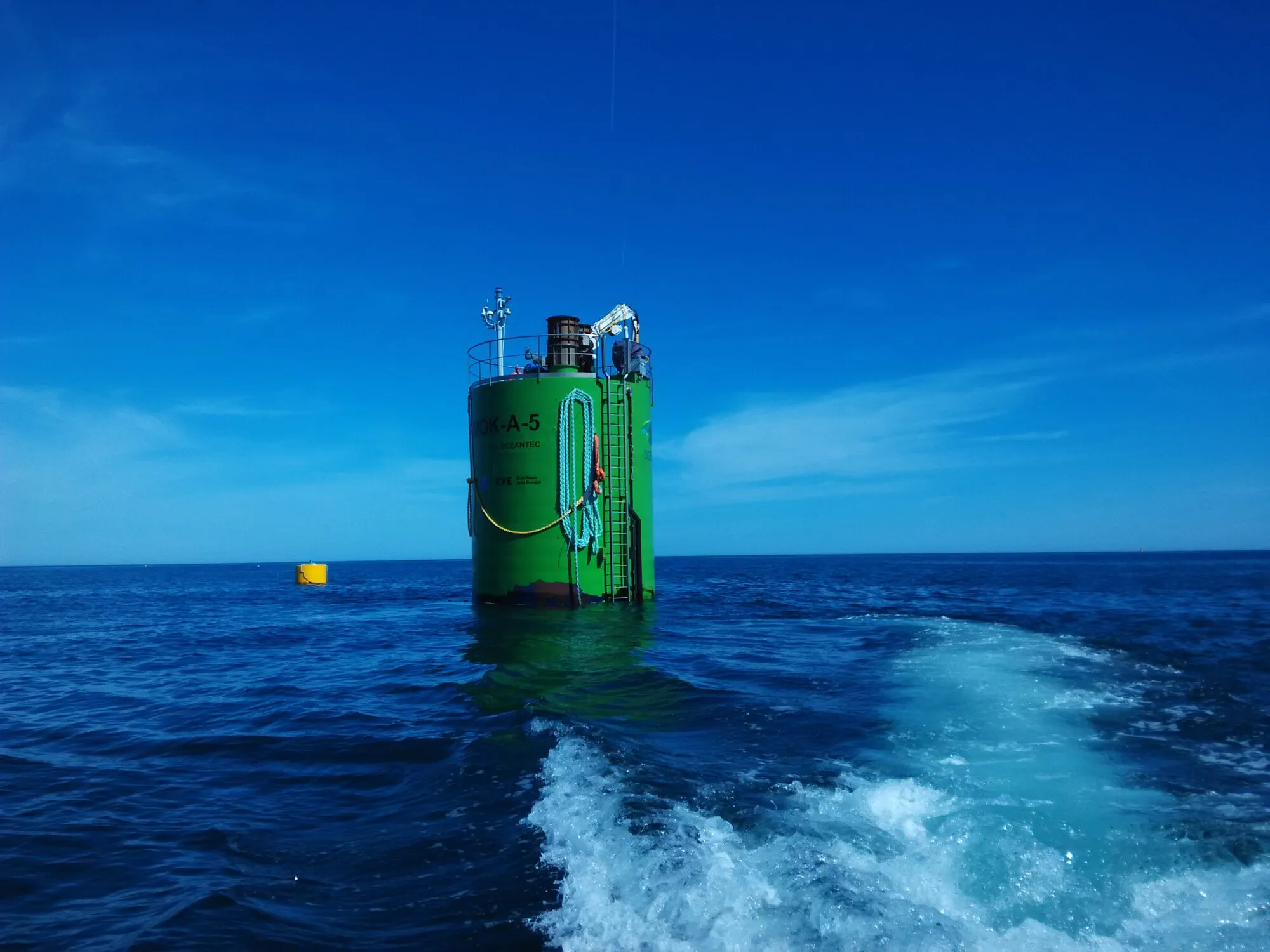
| 3. Sheltered sea trial | A 1:4 to 1:10 machine at a nursery site such as EMEC’s Scapa Flow or BiMEP in Spain, exporting to a load bank | Real power, moorings, maintenance, a winter at sea | $0.5 million to $3 million | 1 to 2 years |
| 4. Full scale | One machine at an open-sea grid-connected berth | Bankable performance and survival data | $10 million and up | several years |
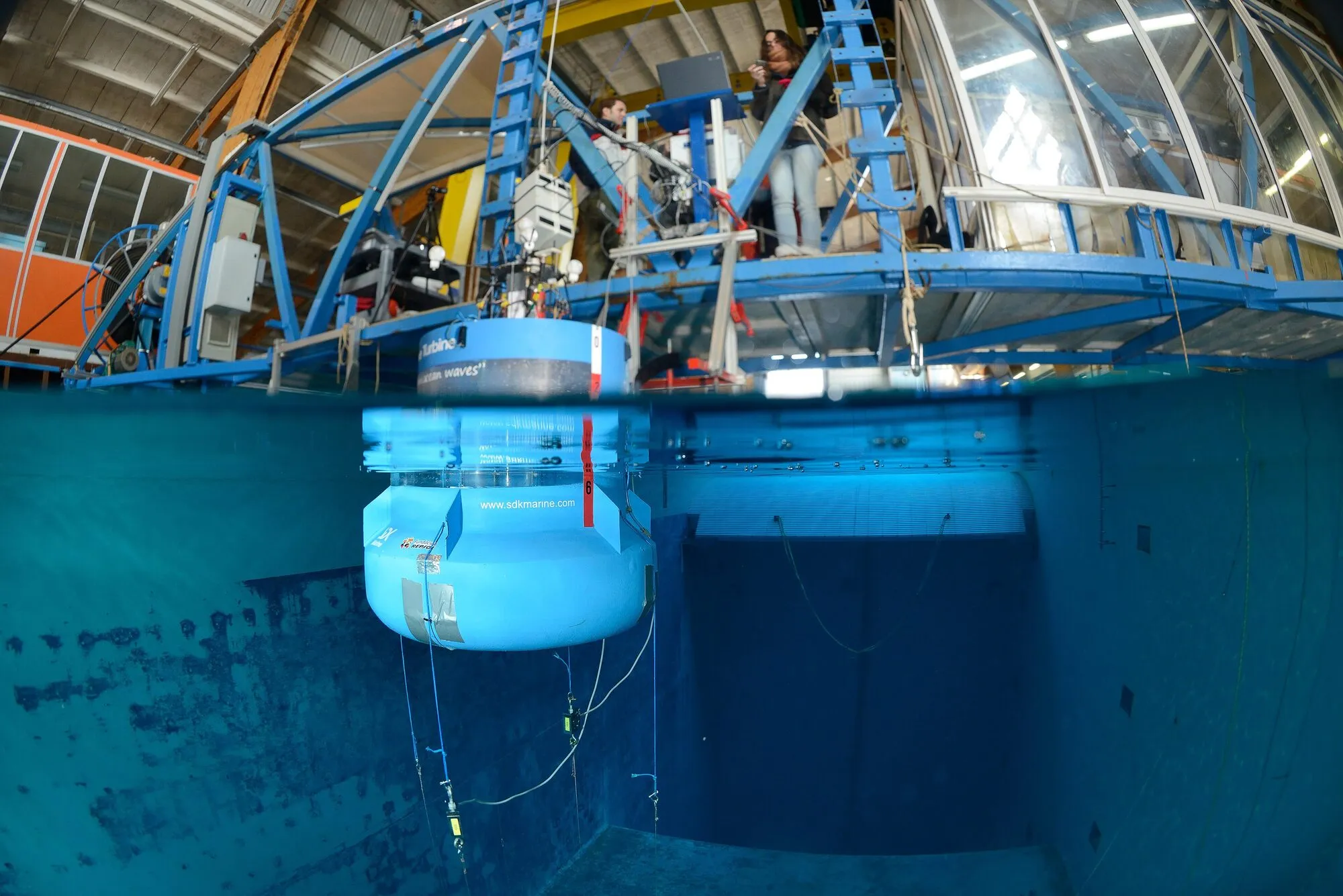
Stage 2 is where a pitch starts to be credible: a model in a wave tank with a measured power take-off, showing both what it catches and what it survives.
Who we need
- Ocean engineers and hydrodynamicists with wave-structure interaction and control experience.
- Wave tank facilities at universities and national laboratories.
- Power take-off specialists: hydraulics, linear generators, magnetic gearing.
- Mooring and offshore structural engineers.
- Marine operations people who have installed and recovered equipment at sea.
- Marine ecologists for noise and entanglement monitoring.
- Users at sea: fish farms, ocean observatories and island utilities that would buy the first machines.
Have a better idea?
Some members of the Foundation may have contacts who could hear a pitch. To be pitched, an idea needs a working, real-life model that actually produces power, with its output measured on an instrument, not claimed: a model in a wave tank with a logged power take-off says more than any animation. Paper ideas are welcome too: if the physics and the numbers are solid, we can publish them here on the website. But raising capital without a working model is very difficult, and nothing here is a promise of funding, returns or introductions.
Send your idea through the contribution form, choosing the Green Initiative. Tell us which waves it is designed for, the capture width you expect and why, how it survives a storm, a rough cost per kWh, and the cheapest test that could prove it wrong. The energy sources page compares wave power with eleven other ideas.
Sources
- Gunn, K. and Stock-Williams, C. (2012). Quantifying the global wave power resource. Renewable Energy 44, 296-304.
- Falnes, J. (2002). Ocean Waves and Oscillating Systems: Linear Interactions Including Wave-Energy Extraction. Cambridge University Press.
- Babarit, A. (2015). A database of capture width ratio of wave energy converters. Renewable Energy 80, 610-628.
- Ocean Energy Systems (2015). International levelised cost of energy for ocean energy technologies.
- Wave power, Wikipedia: the deep-water power flux formula.
- Pelamis Wave Energy Converter, Wikipedia.
- Aquamarine Power, Wikipedia.
- Mutriku Breakwater Wave Plant, Wikipedia, and Pacific Northwest National Laboratory, Tethys, Mutriku wave power plant.
- Wave Hub, Wikipedia.
- CorPower Ocean, Wikipedia, and CorPower Ocean (2026), world-first DNV certification for wave energy technology.
- Wave Energy Scotland. Public library of programme reports.
- Lazard (June 2026). Levelized Cost of Energy+, version 19.
- Local Solar System Foundation. The Fan Wall: open model and benchmark, rooftop solar at $0.19 per kWh.
- Islay LIMPET, Wikipedia: a 250 kW shoreline oscillating water column, grid-connected in 2000 and decommissioned in 2011.
- Wave Dragon, Wikipedia: the 1:4.5 scale prototype in Nissum Bredning, 2003 to 2010.
- BiMEP (2026). BiMEP is hosting IDOM’s new floating device: the MARMOK-A5 oscillating water column, and an earlier version tested from 2016 to 2019.
- Airy wave theory and Wells turbine, Wikipedia: particle orbits under waves, and an air turbine that turns the same way in both directions.