
Sand and heat batteries
A silo of sand is not glamorous, but it can hold a week of a town's heat. The physics is simple, the limits are clear, and the trick is knowing what the stored heat should be used for.
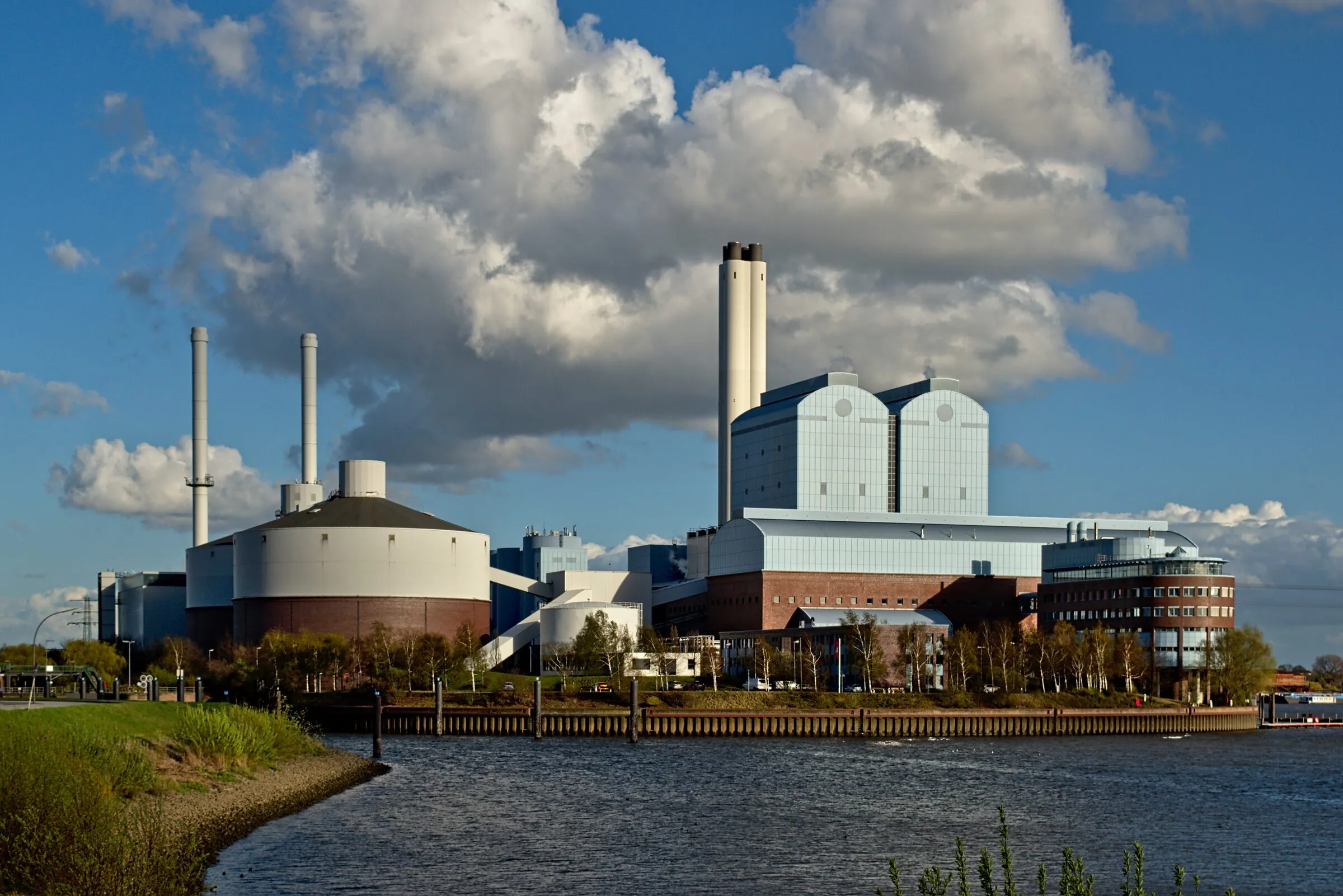
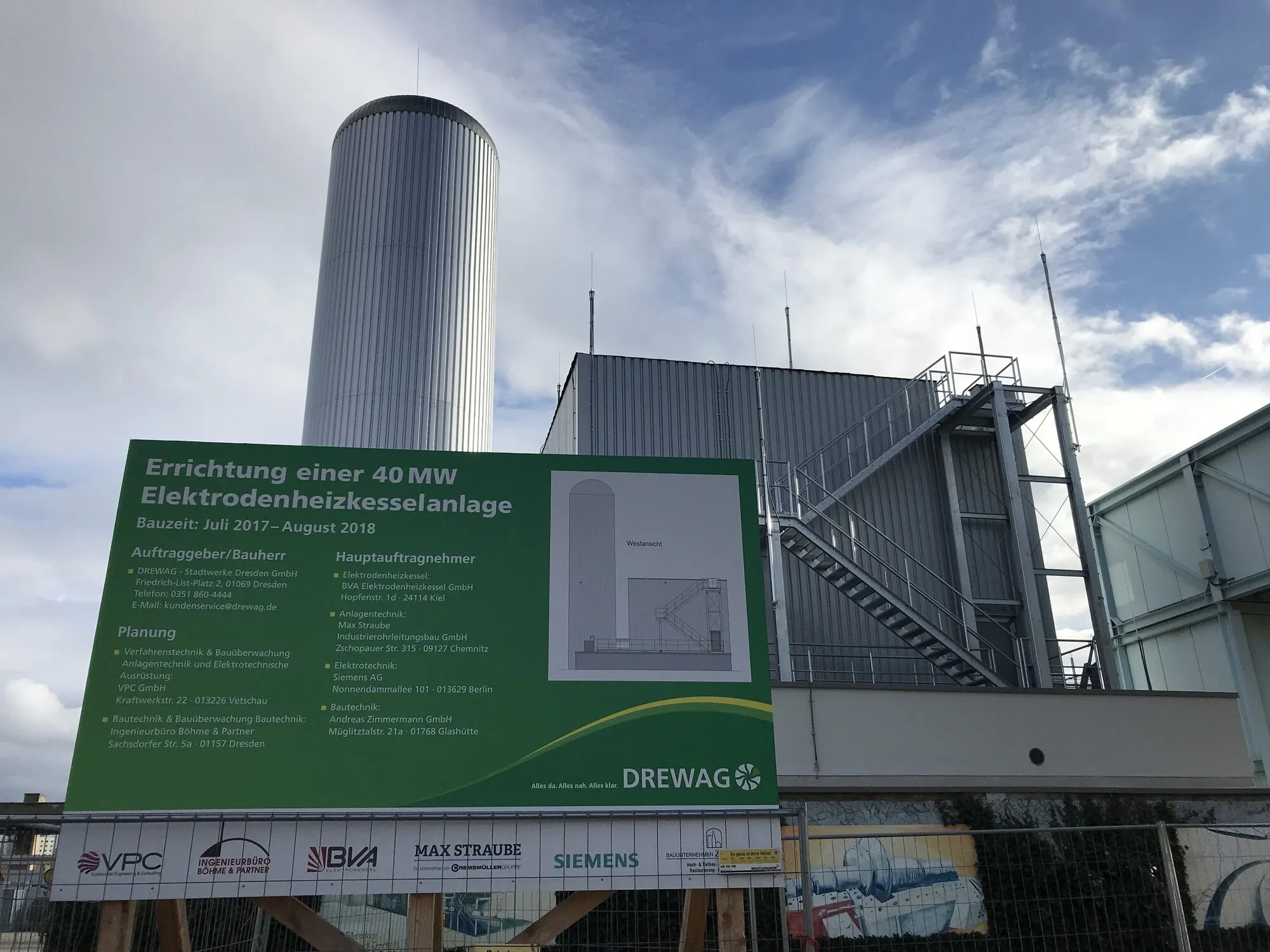
Sebastian Koppehel / Wikimedia Commons (CC BY 4.0)
On windy, sunny days many European grids now have more electricity than they can use, and the price falls close to zero or even below it. A few hours later the same grid pays a premium. A heat battery is the simplest way to catch the cheap hours: an electric heater warms a large mass of sand, crushed stone or brick to hundreds of degrees, thick insulation keeps the heat in, and a fan or heat exchanger takes it out when it is needed, days or weeks later.
About half of the world’s final energy use is heat, not electricity (IEA, Renewables 2019). Most of it still comes from burning gas, oil, coal or wood. That makes this a big prize, and it is why this page takes a hard look at what heat batteries can and cannot do. The short version: stored as heat and used as heat, electricity comes back at 85 to 95%; turned back into electricity, it comes back at 30 to 41% at best. That single fact decides where the technology wins.
What it is
A heat battery, also called a thermal battery or electrified thermal energy storage, stores electricity as heat in a cheap solid. The Finnish company Polar Night Energy uses a steel silo filled with builder’s sand or crushed soapstone and connects it to a district heating network. Rondo Energy in California heats refractory bricks to more than 1,000 °C to make steam for factories. Antora Energy heats blocks of carbon until they glow and can return either heat or, through special solar-cell-like panels, electricity. Siemens Gamesa ran a pilot in Hamburg that stored heat in volcanic rock at 750 °C and turned it back into electricity with a steam turbine.
These are all the same idea with different temperatures and different customers. The only questions that matter are: how hot, for how long, how cheaply, and what the heat is for.
How it works
Charging. Electricity runs through resistance heaters, the same principle as a kettle or a toaster. This conversion is essentially 100% efficient: every kilowatt-hour of electricity becomes a kilowatt-hour of heat. Polar Night’s silos heat air with resistors and blow it through pipes buried in the sand; Rondo’s heaters radiate directly onto brick.
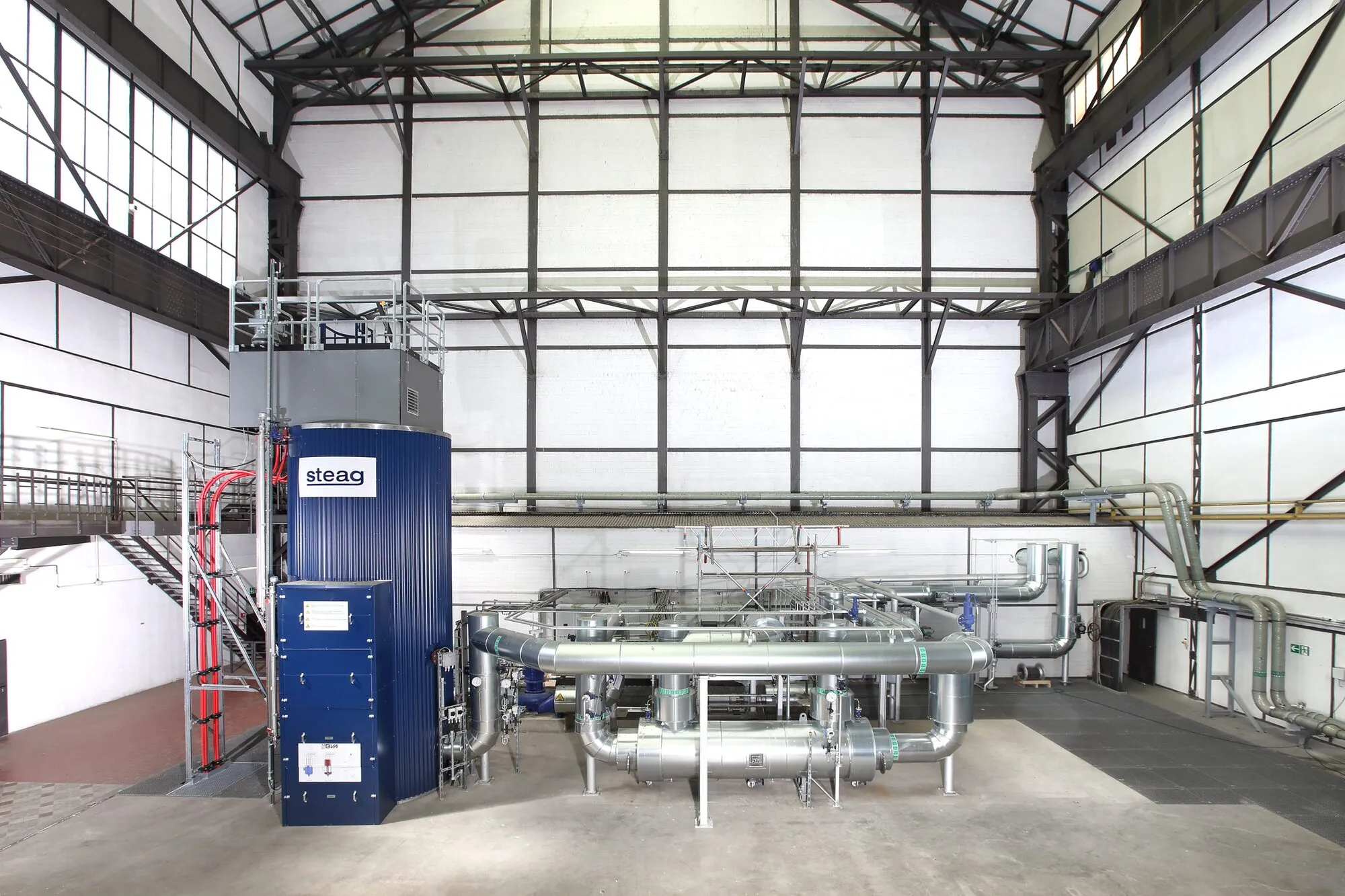
Storing. The energy stored in a solid is E = m × c × ΔT: its mass, times its specific heat, times the temperature swing. Dry sand and most rocks have a specific heat c of about 0.8 to 1.0 kJ per kg per degree. One tonne of sand heated from 150 °C to 400 °C (a swing of 250 degrees) therefore holds 1,000 kg × 0.8 kJ/kg·K × 250 K = 200 MJ, or about 56 kWh. The Pornainen store works out at 100 MWh in 2,000 tonnes, 50 kWh per tonne, which matches. Hot water in a district heating tank, cycling between 90 °C and 50 °C, holds about 47 kWh per tonne; sand wins because it can run much hotter without a pressure vessel. For comparison, lithium-ion battery cells hold roughly 150 to 250 kWh of electricity per tonne.
Keeping it in. Heat leaks out through the surface, at a rate Q = U × A × ΔT, where U measures how good the insulation is, A is the surface area and ΔT the temperature difference to the outside. The stored energy grows with volume (the cube of the size) and the losses with surface (the square), so bigger stores lose a smaller fraction. Our rough estimate for a silo the size of Pornainen’s (15 m wide and 13 m tall, about 970 m² of surface) with insulation that lets through 0.1 W per m² per degree and a 300 degree difference: about 29 kW, or 0.7% of a full store per day. A small store the size of a garden shed would lose several times that fraction, which is why sand batteries are built for towns and factories, not for single houses.
Discharging. For heat, a fan blows air through the hot sand and a heat exchanger passes the heat to water for the network. Nothing about this is exotic. For electricity, the heat has to drive an engine, and here physics sets a hard limit. The Carnot efficiency, the best any heat engine can ever do, is η = 1 − T_cold / T_hot, with temperatures in kelvin. Heat at 400 °C (673 K) rejected at 30 °C (303 K) gives 1 − 303/673 = 55%. At 750 °C the ceiling is 70%. Real steam turbines, pumps and heat exchangers reach roughly half the Carnot figure, so a store returns something like 25 to 40% of the electricity it bought. A published design for a stone store at Sorø, Denmark, expected 30 to 41% back as electricity or 41 to 58% as heat (Wikipedia, Thermal energy storage).
The practical conclusion: a heat battery is an excellent way to buy heat from the electricity grid at the cheapest hours, and a poor way to store electricity for later, unless the heat engine gets much better or the charging power is nearly free.
The limits
- Theoretical. Specific heat and temperature swing fix the energy per tonne; the Carnot equation fixes how much can ever become electricity again. No clever design escapes either.
- Temperature matches the use. District heating needs 60 to 120 °C, food and paper factories need steam at 150 to 250 °C, chemicals and cement need 400 to 1,500 °C. Higher temperatures store more per tonne but need steel, refractory brick and insulation that cost more and wear harder.
- Power versus energy. The heaters and heat exchangers (the power side) are usually more expensive than the sand (the energy side). A store charged only in a few cheap hours needs large heaters that sit idle most of the time.
- Cycles per year. Every euro of equipment has to be paid back by the heat it shifts. A store that cycles 200 times a year spreads its cost far more thinly than one that cycles 20 times. Polar Night says its stores work best between 20 and 200 cycles a year (Solarthermalworld, 2024).
- Cheap electricity has to exist. The business case relies on many hours of low prices. Grids with lots of wind and solar, such as Finland’s, Denmark’s and California’s, have them; grids with little variable power do not.
Real projects, measured
| Project | Where, when | Storage medium and temperature | Size | What is reported |
|---|---|---|---|---|
| Polar Night Energy pilot | Tampere, Finland, 2020 | Sand | 3 MWh | First pilot, run by the company |
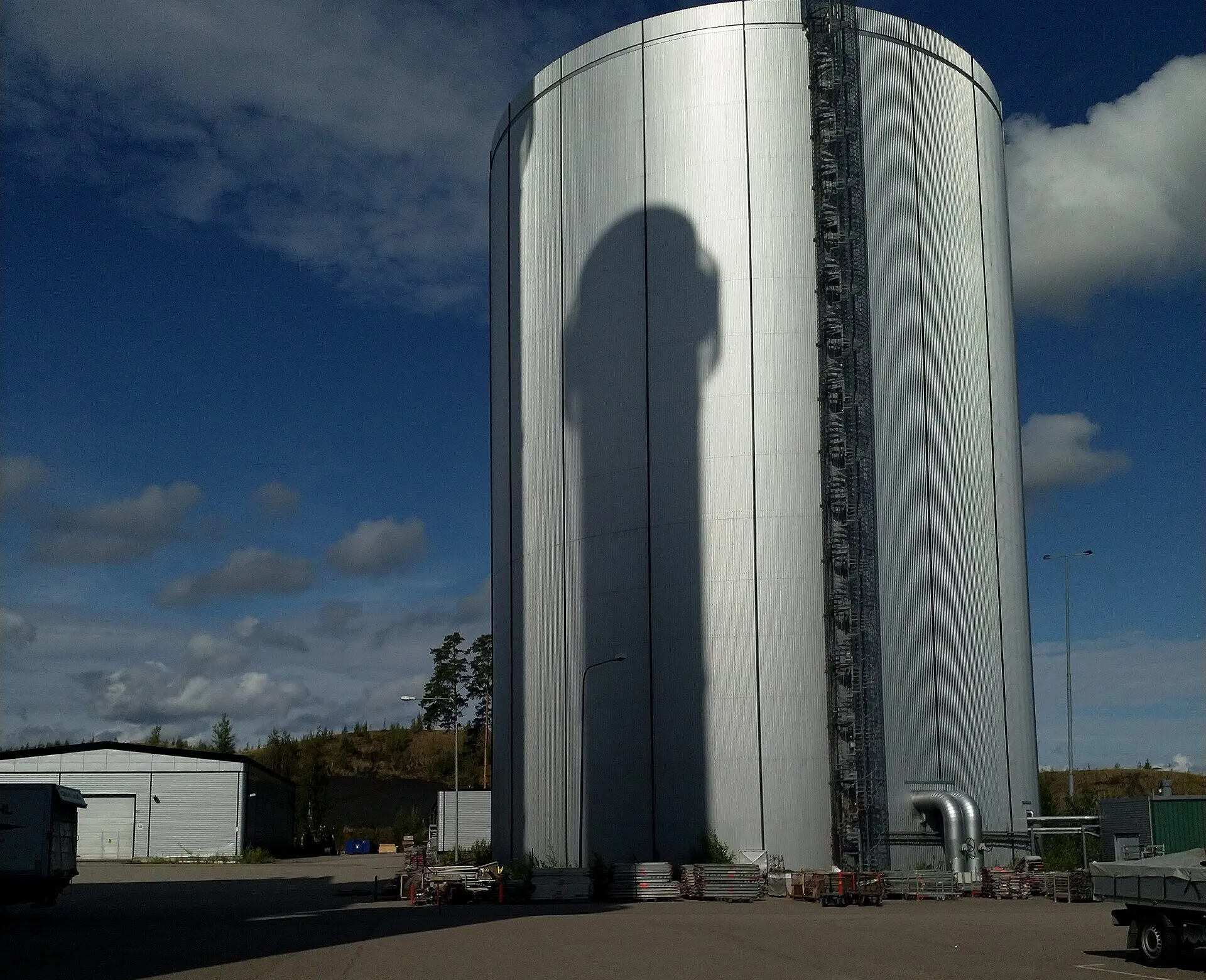
| Polar Night Energy for Vatajankoski | Kankaanpää, Finland, July 2022 | 100 t of builder’s sand in a 4 × 7 m steel silo; heated up to about 500 °C, operated at 150 to 400 °C | 8 MWh | 85% annual efficiency on three-day cycles; 95% targeted for stores above 100 MWh (Solarthermalworld) |
| Polar Night Energy for Loviisan Lämpö | Pornainen, Finland, 2025 | 2,000 t of crushed soapstone, a by-product of fireplace making; up to 400 °C | 100 MWh, 1 MW | 70% lower emissions for the network, about 160 t of CO2 a year, woodchip burning down 60%, oil use ended (ESS News, 2025; Polar Night Energy) |
| Siemens Gamesa ETES pilot | Hamburg-Altenwerder, Germany, 2019 | About 1,000 t of volcanic rock at 750 °C, steam turbine to return electricity | 130 MWh of heat | Stored heat for up to a week; aimed at gigawatt-hour stores (Siemens Gamesa, 2019) |
| Rondo Heat Battery | Several industrial sites; groundbreaking at Covestro, Brunsbüttel, Germany | Refractory brick at 1,100 to 1,500 °C | 2 to over 100 MW of heat per unit | Company states over 98% electricity-to-heat efficiency and over 400 MWh of announced projects (Rondo); not independently published |
| Antora Energy | California, USA | Solid carbon blocks, glowing hot | Industrial scale | Heat, or electricity through thermophotovoltaic cells (Antora). The best laboratory thermophotovoltaic cell has reached 40% efficiency (LaPotin et al., 2022) |
Two cautions about this table. First, most figures come from the companies or their customers, not from independent measurement. Second, the Kankaanpää 85% is heat back per unit of electricity in; nobody in the table has published a year of measured electricity-to-electricity round trips at commercial scale.
Research labs are pushing the temperature up. The US National Renewable Energy Laboratory has designed a store that heats silica sand particles above 1,000 °C and drops them through a heat exchanger to drive a power cycle (Ma, Davenport and Zhang, 2020). Malta, spun out of Alphabet’s X in 2018, pursues a “Carnot battery” that stores heat in molten salt and cold in a chilled liquid to lift the round trip. These are plausible, not proven at scale.
What it costs
Heat batteries do not make electricity, so their honest benchmark is not a solar panel but the heat they replace. Our site-wide benchmark for new electricity on a building remains rooftop solar at about $0.19 per kWh in our open Fan Wall model, inside Lazard’s June 2026 range for commercial rooftop solar of $0.09 to $0.20 per kWh (Lazard LCOE+ 2026). For heat, the competitor is a gas boiler.
What gas heat costs. Using round numbers close to European levels in 2025 and 2026 (wholesale gas at €35 per MWh, a carbon price of €70 per tonne, a 90% efficient boiler), heat from gas costs about 5 to 6 euro cents per kWh before the boiler’s own capital cost. A household on the UK price cap pays 7.97 pence per kWh for gas from October 2026 (Ofgem), about 8.9 pence per kWh of heat.
What stored heat costs. Two parts: the electricity, divided by the efficiency, and the equipment, divided by how much heat it delivers over its life. Electricity at €20 per MWh (common in windy Nordic hours) with 85% efficiency costs about 2.4 cents per kWh of heat. The equipment part depends on the installed cost per kWh of storage capacity and the number of full cycles a year. Neither Polar Night nor its customers have published the price of Pornainen, so we show the range instead of inventing a number (20 years, 7% real discount rate, 90% of capacity used per cycle):
| Installed cost per kWh of capacity | 20 cycles a year | 50 cycles a year | 100 cycles a year | 200 cycles a year |
|---|---|---|---|---|
| $10 | $0.052 | $0.021 | $0.010 | $0.005 |
| $25 | $0.13 | $0.052 | $0.026 | $0.013 |
| $50 | $0.26 | $0.10 | $0.052 | $0.026 |
Equipment cost per kWh of heat delivered, before electricity. Our calculation.
Against lithium-ion. Battery packs averaged $115 per kWh in 2024, a 20% fall in a year (BloombergNEF, 2024), and a complete grid battery costs more than its pack. A lithium-ion battery returns about 85 to 90% of its electricity as electricity. The sand itself costs almost nothing: at tens of dollars per tonne and 50 kWh per tonne, the medium is well under a dollar per kWh. The silo, insulation, heaters and heat exchangers are the real cost. A heat battery only makes sense if its whole installed cost per kWh is several times lower than a lithium battery’s, because what it gives back is heat, not electricity.
Where it can win, and where it cannot
It can win:
- District heating in windy or sunny grids. Nordic and Baltic towns with heat networks, many cheap hours and wood or gas boilers to replace. This is where every commercial sand battery so far has gone.
- Industrial steam and process heat up to about 500 °C in food, drinks, paper and chemicals, where factories currently burn gas around the clock.
- Replacing oil and wood in small networks, as in Pornainen, where the store also saves fuel deliveries and local air pollution.
- Soaking up curtailed wind and solar that would otherwise be switched off, turning a grid problem into a heat product.
- Pairing with large heat pumps: the heat pump covers most hours efficiently, the store covers the price peaks.
It cannot win:
- As a general electricity store. With 25 to 40% back, it loses badly to lithium-ion for daily cycles and to pumped hydro where geology allows.
- In single homes, where surface losses, safety at hundreds of degrees and the cost of small heaters work against it. A hot-water cylinder or a heat pump with a buffer tank does the job better.
- Where electricity is rarely cheap. Without many low-price hours the store has nothing to buy.
- Very high temperatures at small scale. Above 1,000 °C, materials, insulation and safety become a serious engineering programme, not a silo.
What is proven, plausible and speculative
Proven: resistance heating converts electricity to heat almost perfectly; E = m × c × ΔT and the Carnot limit; commercial sand stores deliver district heat in Finland, with 85% reported annual efficiency at 8 MWh; losses fall as stores get larger.
Plausible: 95% annual efficiency at 100 MWh and above; industrial brick stores delivering steam competitively where gas is expensive and cheap power is frequent; installed costs of a few tens of dollars per kWh of capacity.

Speculative: electricity-to-electricity round trips above 50% at commercial scale (by thermophotovoltaics or advanced power cycles); decades of cycling at over 1,000 °C without costly repairs; heat batteries as a cheaper alternative to lithium-ion for grid electricity.
Open research questions
- Independent, published performance data. A year of metered heat in and out, with losses, for each commercial design.
- The real installed cost per kWh of capacity and per kW of power, from tenders rather than press releases.
- Heat exchangers that move heat quickly out of a slow-conducting solid without large temperature drops.
- Materials ageing: sand sintering, brick cracking, steel creep and insulation settling after thousands of cycles.
- Better heat-to-power: thermophotovoltaic cells, supercritical CO2 turbines and Brayton-cycle “Carnot batteries” that could lift the electricity round trip.
- Control and markets: how a store should bid for electricity, and how tariffs and grid fees can reward it for absorbing surplus power.
What a working prototype would need
Anyone who wants to test a new heat battery idea should start small and measure everything. A useful first model delivers measured heat, not a claim.
| Phase | Work | Decision it enables | Rough cost | Time |
|---|---|---|---|---|
| 1. Bench test | 50 to 200 kg of the storage material in an insulated steel drum, a 2 to 5 kW heater, thermocouples at several depths, an air or water heat exchanger, an electricity meter and a heat meter | Energy per kg, charge and discharge rates, heat loss per day, measured heat out per kWh in | $5k to $20k | 2 to 4 months |
| 2. Cycling | 100 or more charge and discharge cycles, materials inspected before and after | Durability and efficiency drift | $10k to $30k | 6 months |
| 3. Pilot | 0.5 to 2 MWh unit on a real heat user (a greenhouse, a school, a small network), with a year of data | Cost per kWh of heat in real operation | $150k to $500k | 12 to 18 months |
Who we need
- Thermal engineers in heat transfer, insulation and heat exchanger design.
- Materials scientists for sands, stones, bricks and ceramics at high temperature over thousands of cycles.
- District heating operators willing to share load data or host a pilot.
- Power-market analysts to model charging strategies and revenues.
- Industrial energy managers who know where process steam is used and what it costs.
- Safety and certification specialists for pressure equipment, fire and high-temperature surfaces.
Have a better idea?
Some members of the Foundation may have contacts who could hear a pitch for a strong energy idea. To be pitched, an idea needs a working, real-life model that actually produces power; for a storage idea like this one, that means a model that delivers stored energy back, with its heat or electricity measured on an instrument, not claimed. Paper ideas are welcome too: if the physics and the numbers are solid, we can publish them here on the website. But raising capital without a working model is very difficult, and nothing here is a promise of funding, returns or introductions.
If you have an idea, send it through the contribution form with the problem it solves, the physics check, a rough cost per kWh, and the cheapest test that could prove it wrong. If you have a working model, include its measured output and how you measured it. The energy sources page compares this and the other alternatives on the idea radar.
Sources
- IEA (2019). Renewables 2019: heat is about half of final energy consumption.
- Polar Night Energy (2025). Pornainen sand battery reference and Kankaanpää reference.
- Solarthermalworld (2024). Sand batteries provide heat to district heating networks in Finland.
- Hall, M. (2025). Finnish 100 MWh sand battery is operational. ESS News.
- Siemens Gamesa (2019). World first: Siemens Gamesa begins operation of its innovative electrothermal energy storage system (archived).
- Wikipedia. Thermal energy storage, including the Sorø design figures.
- Rondo Energy. Rondo Heat Battery (company claims).
- Antora Energy. Thermal batteries (company information).
- LaPotin, A. et al. (2022). Thermophotovoltaic efficiency of 40%. Nature 604, 287-291.
- Ma, Z., Davenport, P. and Zhang, R. (2020). Design analysis of a particle-based thermal energy storage system for concentrating solar power or grid energy storage. Journal of Energy Storage 29, 101382.
- BloombergNEF (2024). Lithium-ion battery pack prices see largest drop since 2017, falling to $115 per kilowatt-hour.
- Lazard (June 2026). Levelized Cost of Energy+, version 19.
- Ofgem (2026). Energy price cap unit rates, 1 October to 31 December 2026.
- Local Solar System Foundation. The Fan Wall open model: the rooftop solar benchmark of $0.19 per kWh.
- Wikipedia. Andasol Solar Power Station: molten salt storage of about 7.5 hours at full load per unit.
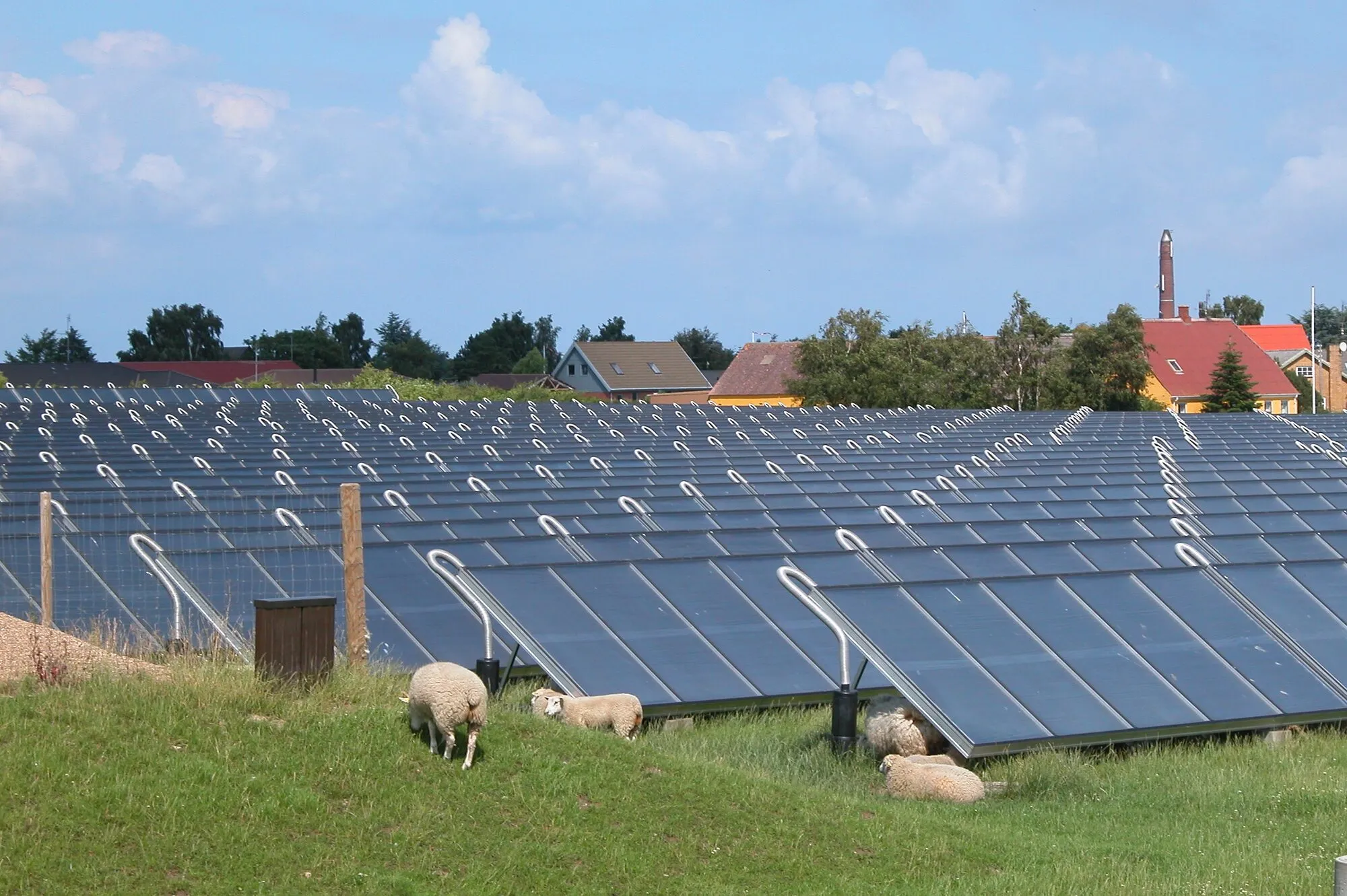
- Wikipedia. Seasonal thermal energy storage: the Marstal pit store fed by solar collectors.
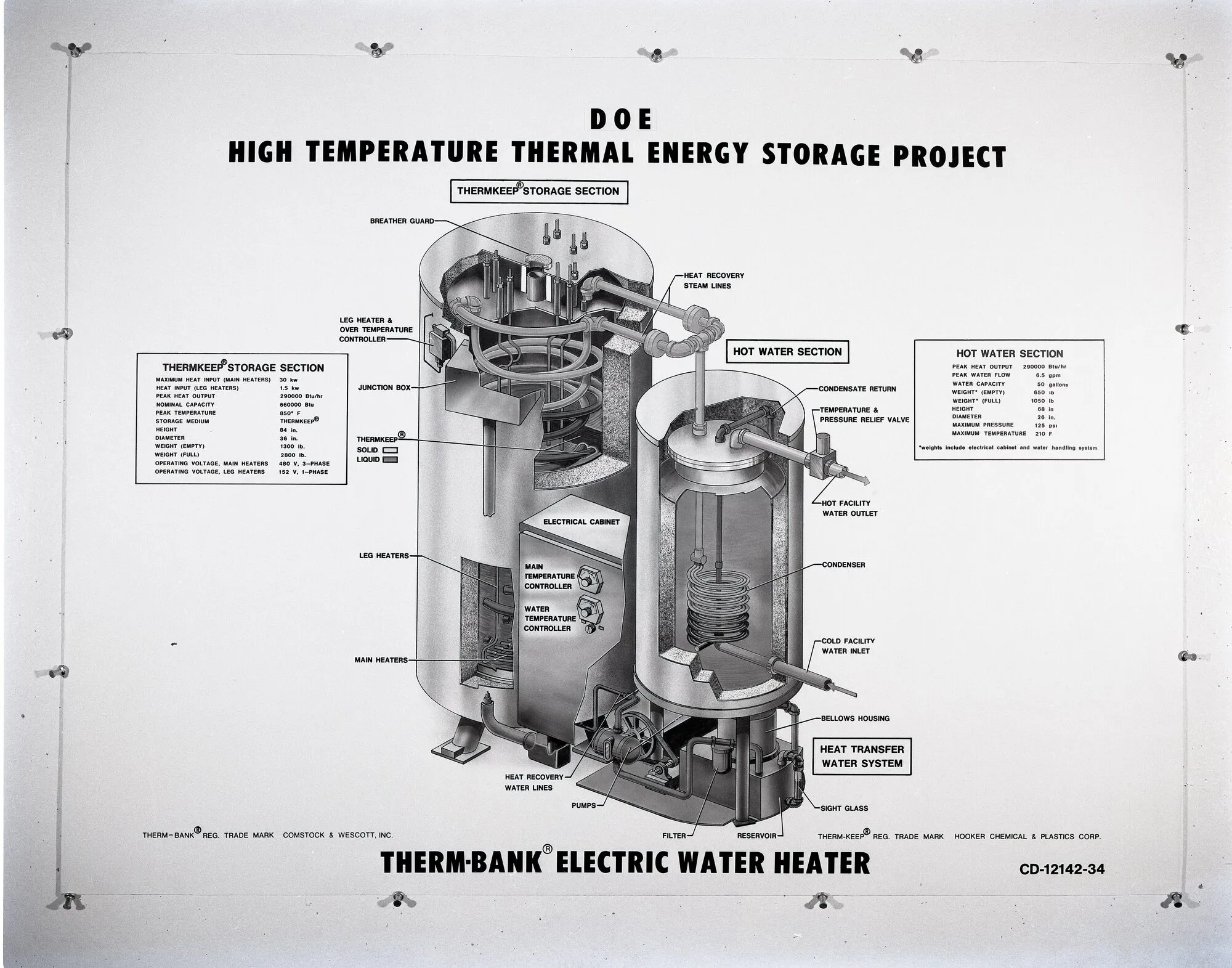
- US Department of Energy (1978). High Temperature Thermal Energy Storage Project: Therm-Bank electric water heater, display photograph, US National Archives.
