
Newton's Cannon
A na Birenzeho Birenzeho Kuva: A Uruzi Hejuru: & Kugeza, Hanyuma.
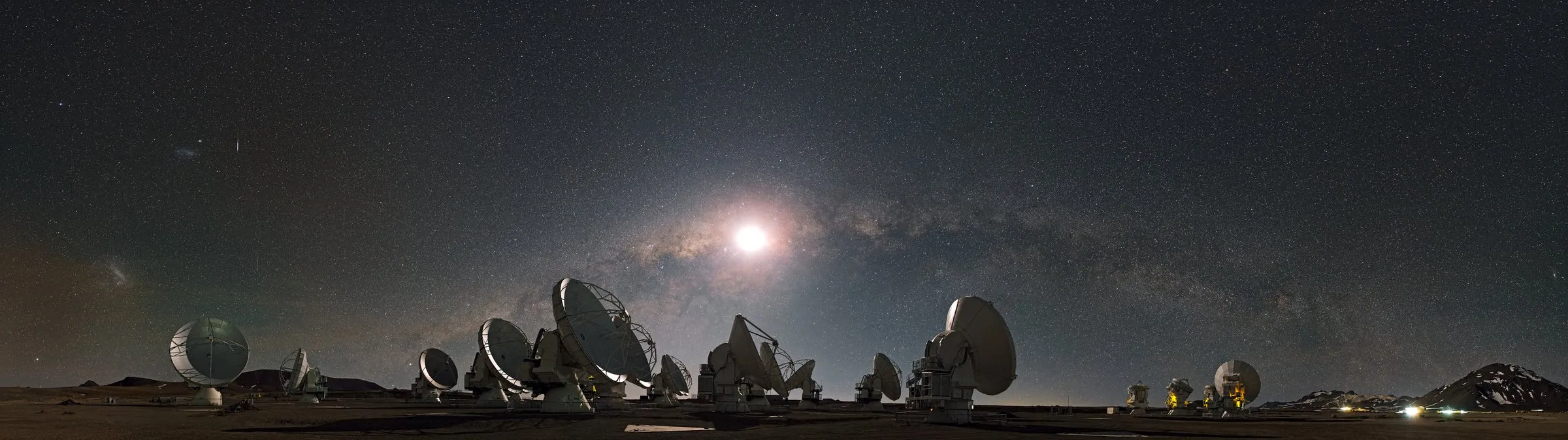
ESO/S. Guisard (www.eso.org/~sguisard) (CC BY 4.0)
Newton's Cannon
ni? Isaac Newton imagined a cannon on a mountain so tall that it pokes out of the air. Fire the ball slowly and it falls back down. Fire it fast enough and the ground curves away beneath it as fast as it falls, so it never lands. That is an orbit.
Gukoresha: i Tangira & vendorShortName; Umuvuduko Na: i Cyangwa A Umuvuduko Akabuto, Hanyuma Kanda. ku Mugaragaza Gutandukanya.
ni?
- Shot
- Jet airliner, about 900 km/h (0.25 km/s)
- 1. S
- Umuvuduko
- Umuvuduko
The mountain is drawn far taller than any real one so you can see it. Air resistance is ignored.
iyi
- Press "Jet airliner" and fire, then "Rifle bullet" and fire.Icyegeranyo: Gukuraho Inyuma Hasi Ku Rimwe. Bihuta buri munsi ni Oya hafi Byihuta Kuri.
- Umuvuduko naIcyegeranyo: The ball goes all the way round and comes back to the cannon. It is falling the whole time, but it keeps missing the ground. This is how the International Space Station stays up.
- Fire a little slower than orbit speed, then a little faster.Icyegeranyo: Slower: it curves down and lands part of the way round. Faster: the circle stretches into a long oval that swings far out and comes back.
- Press "Escape speed" and fire, then switch the planet to the Moon.Icyegeranyo: At escape speed the ball leaves and never comes back. On the Moon, with its weaker gravity, orbit speed is only about 1.6 km/s.
Ibitekerezo
i Hasi
It does fall, all the time. Earth's surface curves downwards by about 5 metres for every 8 kilometres you travel, and anything dropped falls about 5 metres in its first second. So a ball moving sideways at about 8 kilometres per second falls 5 metres each second while the ground drops away by 5 metres. It never gets any closer to the ground.
A Ubuhagarike:
On Earth the mountain here is about 510 km high (8% of Earth's radius), higher than the International Space Station flies (about 400 km), so the ball starts above almost all of the air. Down in the air, drag would slow and heat the ball long before it reached orbit speed. That is why real rockets climb out of the air first and then speed up sideways.
Sources: planet masses and sizes from NASA/JPL (bodies.json); paths are exact two-body orbits. Everyday speeds are typical round figures: jet airliners cruise at about 900 km/h, and rifle bullets leave the barrel at roughly 0.7 to 1.2 km/s, about 1 km/s for a fast one.
The pull every object has on every other. Earth's gravity pulls everything towards its centre, which is why things fall.
in i Inkoranyamagambo →Inzira: Bya A Cyangwa Star Buri gihe, ni Himura Bihuta.
in i Inkoranyamagambo →The speed you must go sideways to circle a planet at a given height without falling in or flying away. Just above Earth's air it is about 7.8 km/s.
in i Inkoranyamagambo →The speed needed to leave a planet for good, never falling back. From Earth's surface it is about 11.2 km/s, ignoring the air.
in i Inkoranyamagambo →Air pushing against a moving object and slowing it down. This tool ignores it; a real cannonball fired this fast would be stopped and burned up by the air.
Ibyatanzwe imbonerahamwe# Umwandiko Igisubizo
i Umurongo: Umuvuduko: Inyuma. Umurongo: na Kwiruka Umuvuduko:. Cyangwa hejuru Kwiruka Umuvuduko: ya:.
| Isi | Umuvuduko | Umuvuduko |
|---|---|---|
| Earth | 7,61 km/s | 10,8 km/s |
| The Moon | 1,62 km/s | 2,29 km/s |
| Mars | 3,42 km/s | 4,84 km/s |
Tools and lessons use simplified models for learning only. They must not be used for navigation, mission planning or any operational decision. Certificates are free and non-accredited. i Ibigize