
Scale Walk
Scroll from the Sun to Neptune at true scale, with light-travel time markers along the way.
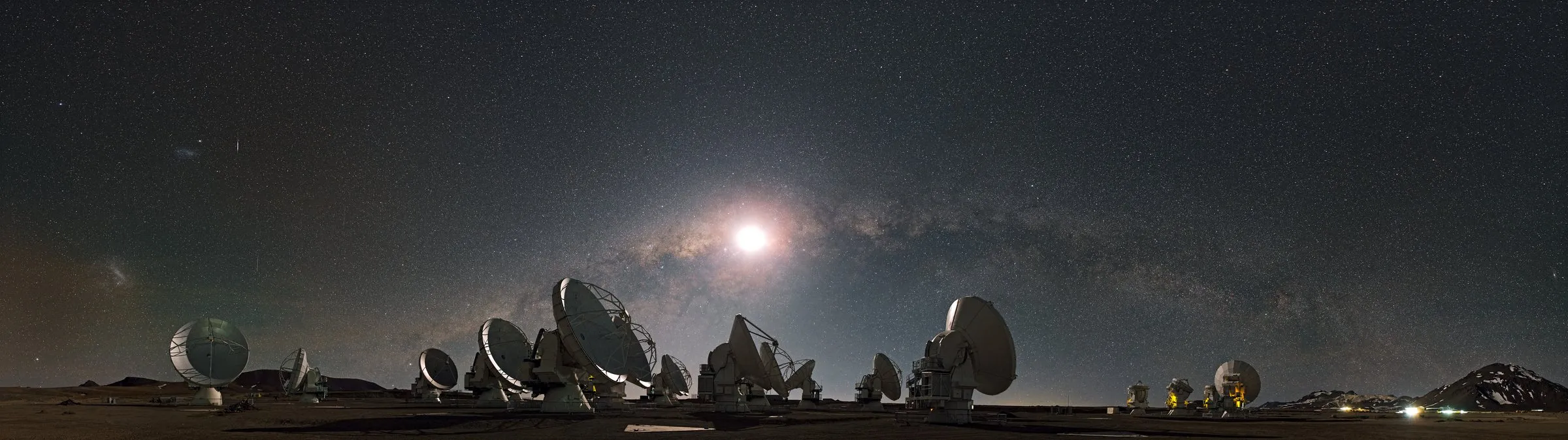
ESO/S. Guisard (www.eso.org/~sguisard) (CC BY 4.0)
Scale Walk
Everything here is at true scale: sizes and distances in the same proportion. Each pixel you scroll carries you 3,000 km.
Keep scrolling. Every picture you have seen of the solar system squeezed this emptiness out.
Mercury is ahead, where sunlight is almost seven times stronger than on Earth.
Still nothing. You have crossed 16.8 million km since Mercury.
The sunlight passing you now left the Sun 5 min 5 sec ago.
Earth is ahead. Watch how small home turns out to be.
Mars is still 58.8 million km ahead.
A radio message from Earth takes between 3 and 22 minutes to reach Mars, depending on where the two planets are.
You could line up 4,611 Earths side by side in the space you have crossed since Earth.
You are 14% of the way from Mars to Ceres.
Still nothing. You have crossed 53.1 million km since Mars.
The sunlight passing you now left the Sun 17 min 6 sec ago.
Ceres is still 79.6 million km ahead.
You are inside the asteroid belt. Did you hit anything? On average the asteroids are about a million kilometres apart.
You could line up 12,497 Earths side by side in the space you have crossed since Mars.
You are 17% of the way from Ceres to Jupiter.
Still nothing. You have crossed 122 million km since Ceres.
The sunlight passing you now left the Sun 33 min 8 sec ago.
Jupiter is still 122 million km ahead.
You could line up 23,846 Earths side by side in the space you have crossed since Ceres.
You are 10% of the way from Jupiter to Saturn.
Still nothing. You have crossed 130 million km since Jupiter.
The sunlight passing you now left the Sun 54 min 5 sec ago.
Saturn is still 389 million km ahead.
Voyager 1 took about 20 months to fly from Jupiter to Saturn.
You could line up 30,529 Earths side by side in the space you have crossed since Jupiter.
You are 70% of the way from Jupiter to Saturn.
Still nothing. You have crossed 519 million km since Jupiter.
The sunlight passing you now left the Sun 1 hr 16 min ago.
Uranus is still 1.31 billion km ahead.
You could line up 20,605 Earths side by side in the space you have crossed since Saturn.
You are 27% of the way from Saturn to Uranus.
Still nothing. You have crossed 525 million km since Saturn.
Uranus orbits twice as far from the Sun as Saturn. The farther out you go, the emptier it gets.
The sunlight passing you now left the Sun 2 hr 3 min ago.
Uranus is still 525 million km ahead.
You could line up 82,418 Earths side by side in the space you have crossed since Saturn.
You are 82% of the way from Saturn to Uranus.
Still nothing. You have crossed 1.31 billion km since Saturn.
The sunlight passing you now left the Sun 2 hr 48 min ago.
Neptune is still 1.33 billion km ahead.
You could line up 34,840 Earths side by side in the space you have crossed since Uranus.
You are 36% of the way from Uranus to Neptune.
Still nothing. You have crossed 740 million km since Uranus.
Voyager 2 needed about three and a half years to cross this gap, from Uranus in 1986 to Neptune in 1989.
The sunlight passing you now left the Sun 3 hr 37 min ago.
Neptune is still 444 million km ahead.
You could line up 104,519 Earths side by side in the space you have crossed since Uranus.
You are 91% of the way from Uranus to Neptune.
Still nothing. You have crossed 129 million km since Neptune.
The sunlight passing you now left the Sun 4 hr 24 min ago.
The Kuiper belt: a ring of icy worlds so spread out that after Pluto, New Horizons flew close to just one of them.
Pluto is still 906 million km ahead.
You could line up 50,798 Earths side by side in the space you have crossed since Neptune.
You are 55% of the way from Neptune to Pluto.
Still nothing. You have crossed 906 million km since Neptune.
New Horizons, one of the fastest spacecraft ever launched, took nine and a half years to reach Pluto. Sunlight gets to Pluto's average distance in about five and a half hours.
The sunlight passing you now left the Sun 5 hr 15 min ago.
Pluto is still 129 million km ahead.
Scroll down inside the frame to fly outward, or start the autopilot below.
Journey's end
Look back. That bright star is the Sun.
Data table (text alternative)
| World | Diameter | Distance from the Sun | Light-travel time from the Sun | px |
|---|---|---|---|---|
| Mercury | 4,879 km | 0.387 au | 3 min 13 sec | 19,303 |
| Venus | 12,104 km | 0.723 au | 6 min 1 sec | 36,070 |
| Earth | 12,742 km | 1 au | 8 min 19 sec | 49,866 |
| Mars | 6,779 km | 1.52 au | 12 min 40 sec | 75,981 |
| Ceres | 939 km | 2.77 au | 23 min 0 sec | 137,907 |
| Jupiter | 139,822 km | 5.2 au | 43 min 16 sec | 259,447 |
| Saturn | 116,464 km | 9.54 au | 1 hr 19 min | 475,555 |
| Uranus | 50,724 km | 19.2 au | 2 hr 40 min | 956,886 |
| Neptune | 49,244 km | 30.1 au | 4 hr 10 min | 1,499,465 |
| Pluto | 2,377 km | 39.6 au | 5 hr 29 min | 1,974,125 |
Tools and lessons use simplified models for learning only. They must not be used for navigation, mission planning or any operational decision. Certificates are free and non-accredited. Read the educational content disclaimer