
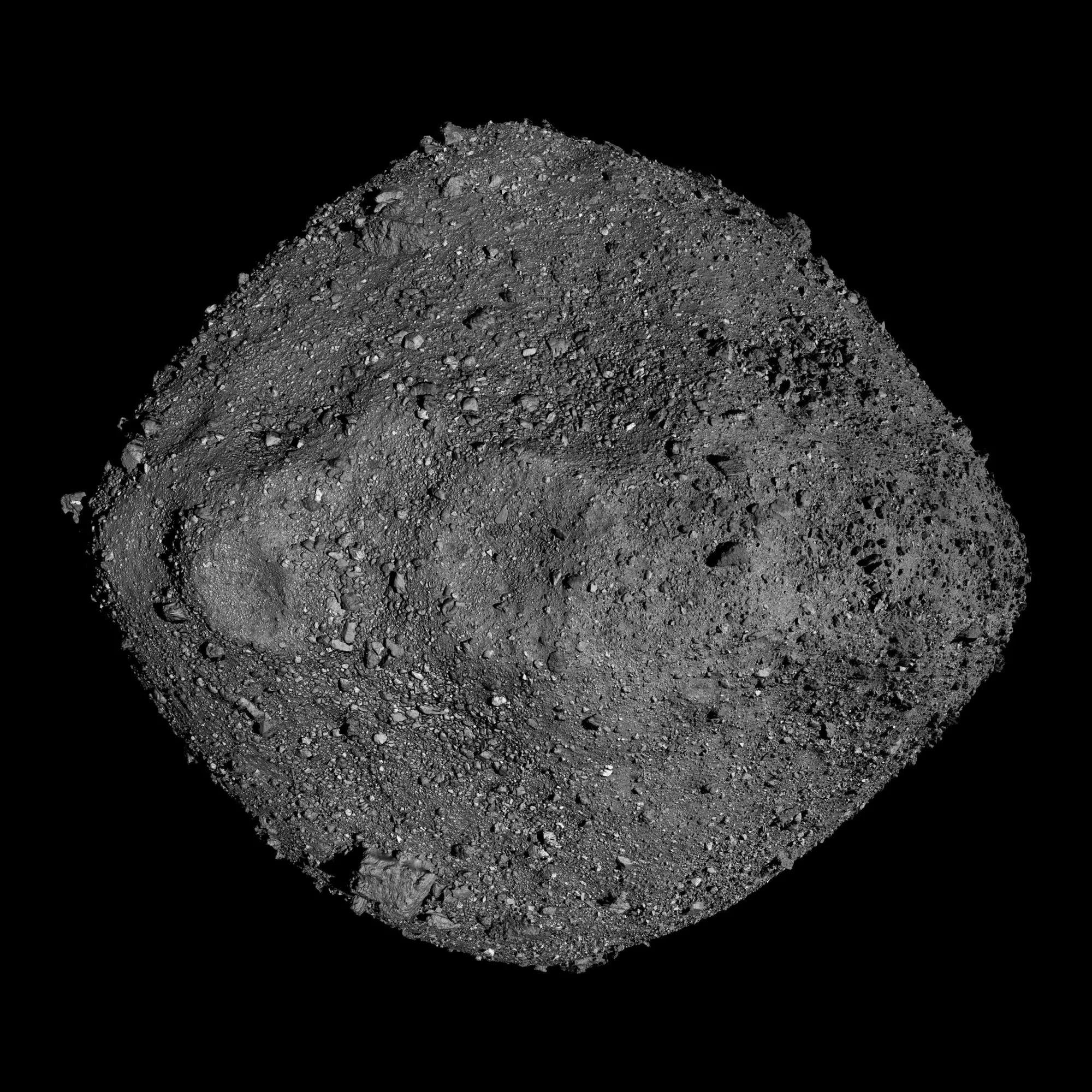
Bennu
Bennu is a 500-metre near-Earth rubble-pile asteroid. NASA's OSIRIS-REx collected 121.6 g of it in 2020 and returned the sample to Earth in 2023.
NASA/Goddard/University of Arizona
A pile of loose rubble held together by almost nothing, and one of the few places in space we have brought a piece of back to Earth.
Bennu is a small, dark, carbon-rich asteroid whose orbit brings it close to Earth’s. NASA’s OSIRIS-REx spacecraft studied it for more than two years, scooped up a sample in October 2020 and delivered it to Earth on 24 September 2023. Those grains are now some of the best-studied material from the early solar system.
How big is Bennu?
Bennu is about 500 m across: roughly 490 m on average and about 565 m (a third of a mile) at its equator, which bulges outward. It is shaped like a spinning top, with a raised ridge around the middle. You could fit it comfortably inside a large city park, and it is only slightly taller than the Empire State Building.
Its mass is about 7.3 × 10¹⁰ kg (73 million tonnes), around a hundred-trillionth of Earth’s. Its density is only about 1.19 g/cm³, barely more than water, even though it is made of rock. That low density means as much as half of Bennu may be empty space between its boulders.
What is Bennu made of?
Bennu is a rubble pile: a loose heap of boulders, pebbles and dust held together by its own feeble gravity rather than by solid rock. The rocks themselves formed about 4.5 billion years ago inside a larger parent asteroid. A collision destroyed that parent body, and Bennu gathered from a small part of the debris, probably within the last 1 to 2 billion years.
It is one of the darkest objects known, reflecting only about 4.4% of the light that hits it, which is darker than charcoal. Its surface is crowded with boulders; the largest are tens of metres across. Gravity at the surface is so weak (less than a hundred-thousandth of Earth’s) that you could throw a pebble off it. In January 2019 OSIRIS-REx even saw Bennu shedding small particles into space, something no one had expected.
Where does Bennu orbit?
Bennu orbits the Sun at an average distance of about 1.13 au, slightly farther out than Earth. Its orbit is moderately eccentric (e ≈ 0.20), ranging from about 0.90 au to 1.36 au, so it crosses Earth’s orbit. One trip around the Sun takes about 436 days, or 1.2 years. It spins once every 4 hours 18 minutes.
NASA says Bennu makes a relatively close pass by Earth about every six years. It is classed as a near-Earth asteroid of the Apollo group, and as potentially hazardous, because of its size and how close its orbit comes to ours.
Could Bennu hit Earth?
The chance is small but not zero, which is why it is closely tracked. Using OSIRIS-REx tracking data, NASA scientists calculated in 2021 a total impact probability of about 1 in 1,750 (0.057%) between now and the year 2300. The single most likely date is 24 September 2182, with a chance of about 1 in 2,700.
Bennu will pass within the Moon’s distance of Earth in 2135, and that encounter will shape its later path. Its orbit is also changed slowly by the Yarkovsky effect, a tiny push from heat radiated off its surface. Measuring that push precisely was one of the mission’s goals. JPL’s Center for Near Earth Object Studies keeps the official risk figures.
What did OSIRIS-REx find on Bennu?
OSIRIS-REx launched on 8 September 2016 and arrived at Bennu on 3 December 2018. After mapping the whole surface, it chose a crater named Nightingale for sampling. On 20 October 2020 it touched down for about six seconds and fired a burst of nitrogen gas to stir up material into its collector. The surface turned out to be so loose that the sampling head sank in like a foot in a ball pit.
The spacecraft left Bennu on 10 May 2021. Its capsule landed in the Utah desert on 24 September 2023, carrying 121.6 g of rock and dust, more than double the mission’s 60 g target. It was the first asteroid sample returned by a US mission; Japan’s Hayabusa and Hayabusa2 had earlier returned samples from Itokawa and Ryugu.
What is in the sample?
Scientists have found clay minerals that formed in water, carbonates, magnesium-sodium phosphate and salts left by evaporating brine. Studies published in 2025 reported 14 of the 20 amino acids used by life on Earth and all five nucleobases found in DNA and RNA. None of this means Bennu ever hosted life, but it supports the idea that asteroids delivered water and the chemical ingredients of life to the young Earth.
Can you see Bennu from Earth?
Not with your eyes or binoculars. Bennu is small and very dark, and even during its close passes you need a sizeable telescope to detect it. It was discovered on 11 September 1999 by the LINEAR survey in New Mexico. In 2013 a nine-year-old from North Carolina won a naming contest with Bennu, a heron-like bird from ancient Egyptian mythology.
The spacecraft has not retired. Renamed OSIRIS-APEX, it is now heading for the asteroid Apophis, which it should reach shortly after Apophis passes close to Earth in April 2029. To learn how missions catch a moving target, see rendezvous and launch windows, and how capsules survive the trip home in reentry.
Data sources
Tools and lessons use simplified models for learning only. They must not be used for navigation, mission planning or any operational decision. Certificates are free and non-accredited. Read the educational content disclaimer