
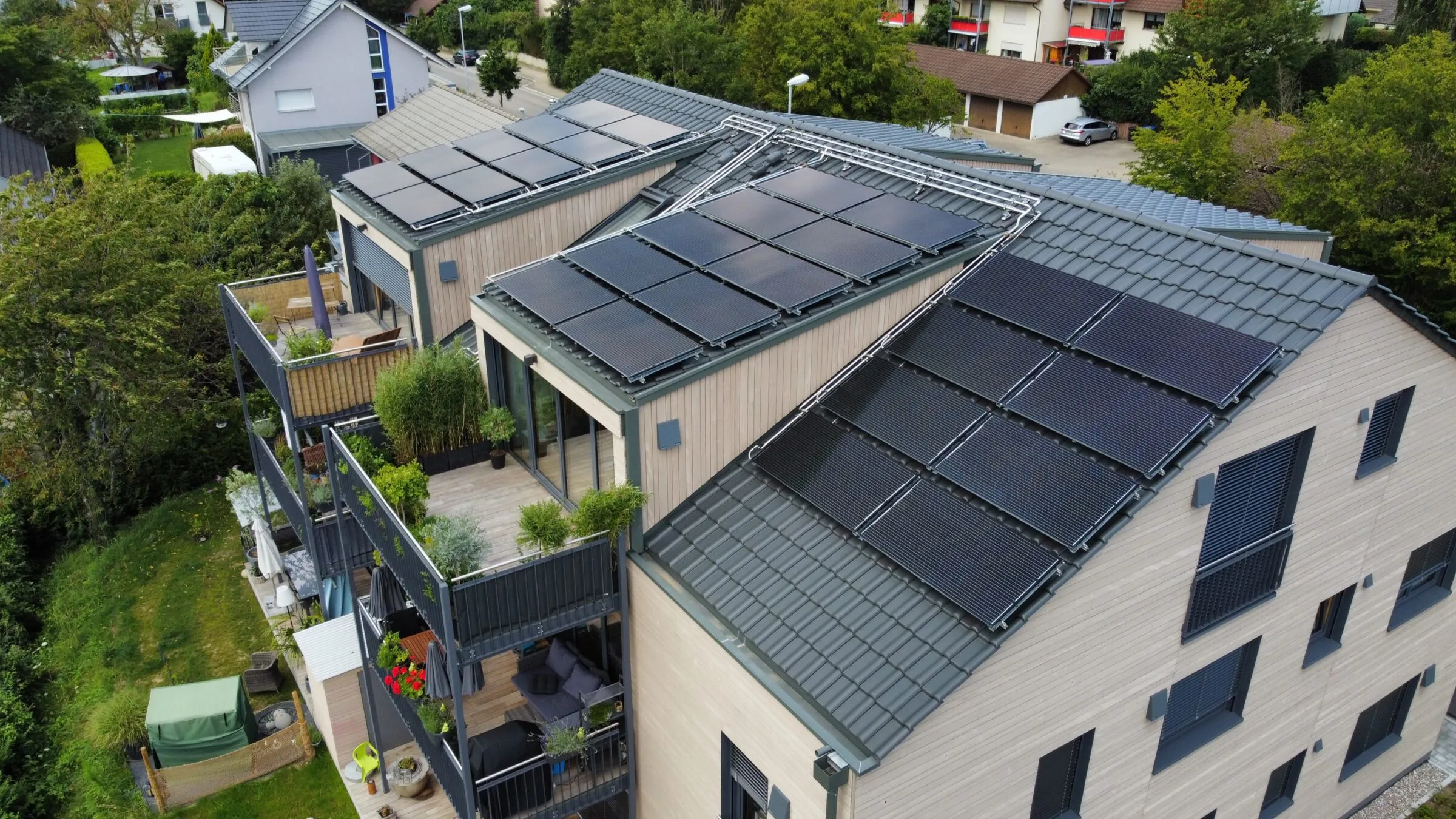
Solar roofs that also heat
A solar panel turns a fifth of the sunlight into electricity and most of the rest into waste heat. A PV-thermal collector keeps that heat. The physics is simple; making it pay is not.
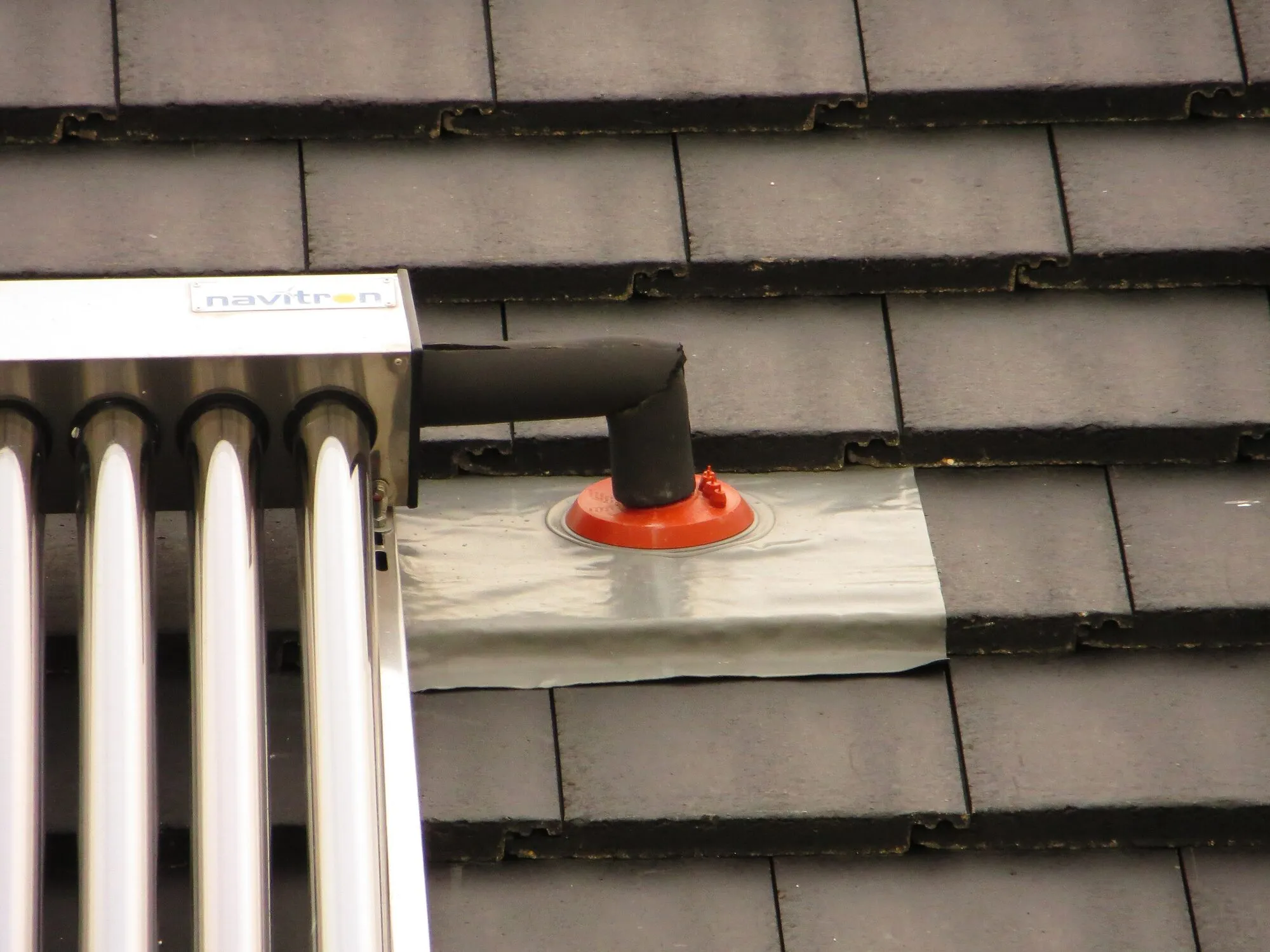
Andreas Siegemund (CC BY-SA 4.0)
Look at a solar panel on a sunny day and most of the energy falling on it is doing nothing useful. The cells turn 15 to 20% of the light into electricity; 65 to 70% of it becomes heat, which warms the panel and makes it less efficient (IEA SHC Task 60, 2020). A photovoltaic-thermal (PVT) collector puts a heat exchanger behind the cells, carries that heat away in water or air, and uses it for hot water, space heating or a heat pump.
The honest summary: PVT works, is sold today and can deliver two to three units of heat for every unit of electricity from the same roof, but it only pays where there is a steady use for low-temperature heat, and its measured costs are still higher than separate panels and collectors in most places. This page explains why, with the numbers.
What it is
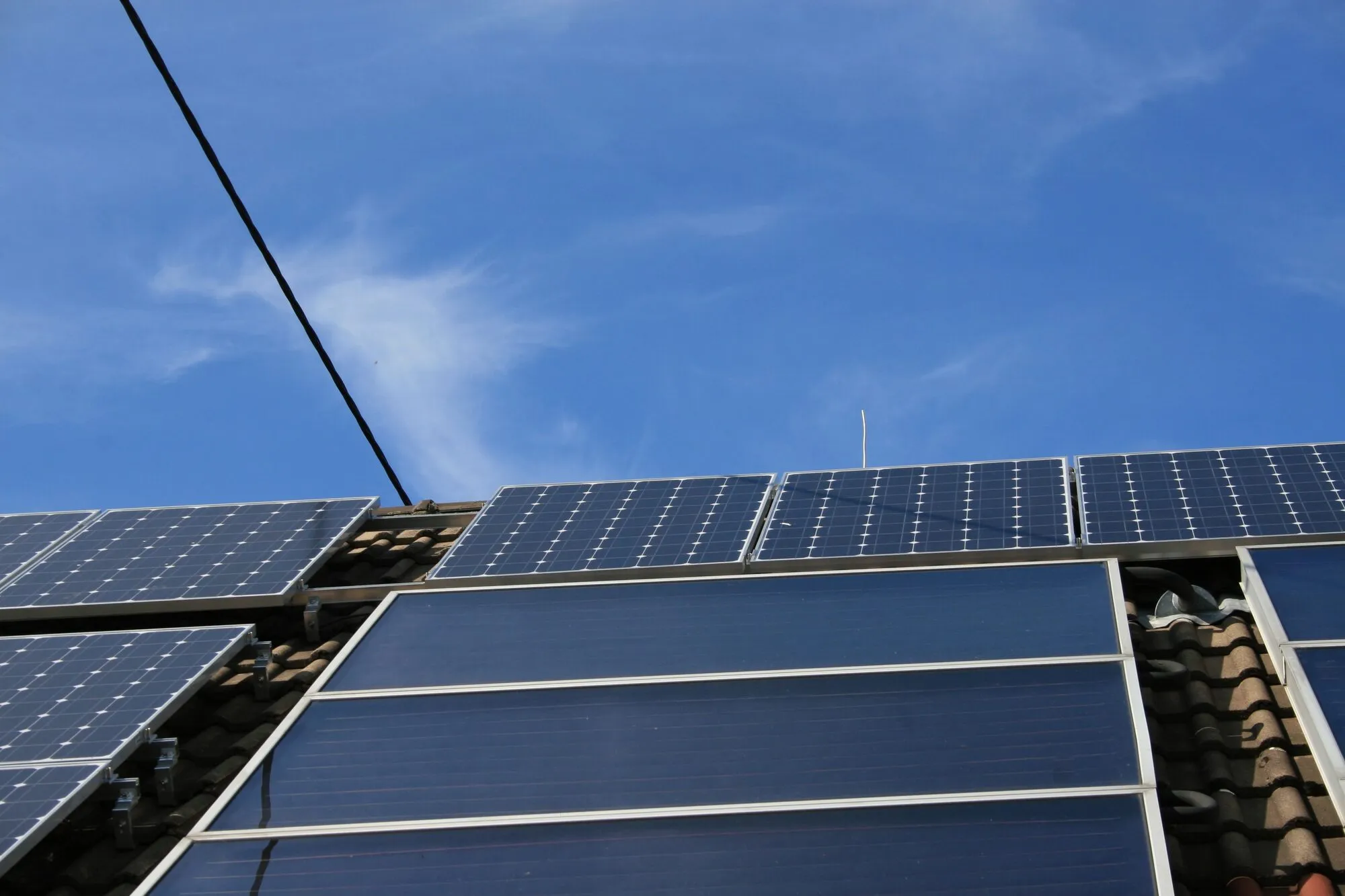
A PVT collector is a solar panel and a solar thermal collector in one frame. There are three main families (IEA SHC Task 60, 2020):
- Uncovered water collectors look like ordinary panels with a flat heat exchanger bonded to the back. They run cool, which suits the cells, and lose heat easily to wind. They are 61% of installed PVT thermal capacity worldwide and are most often used as the heat source for a heat pump.
- Covered (glazed) collectors add a second sheet of glass and an insulating air gap in front of the cells. They reach the 50 to 60 °C that domestic hot water needs, but the extra glass reflects some light and the cells run hotter, so they make less electricity.
- Air collectors blow air behind the panels and use it to warm or ventilate a building. They are 33% of installed PVT capacity.
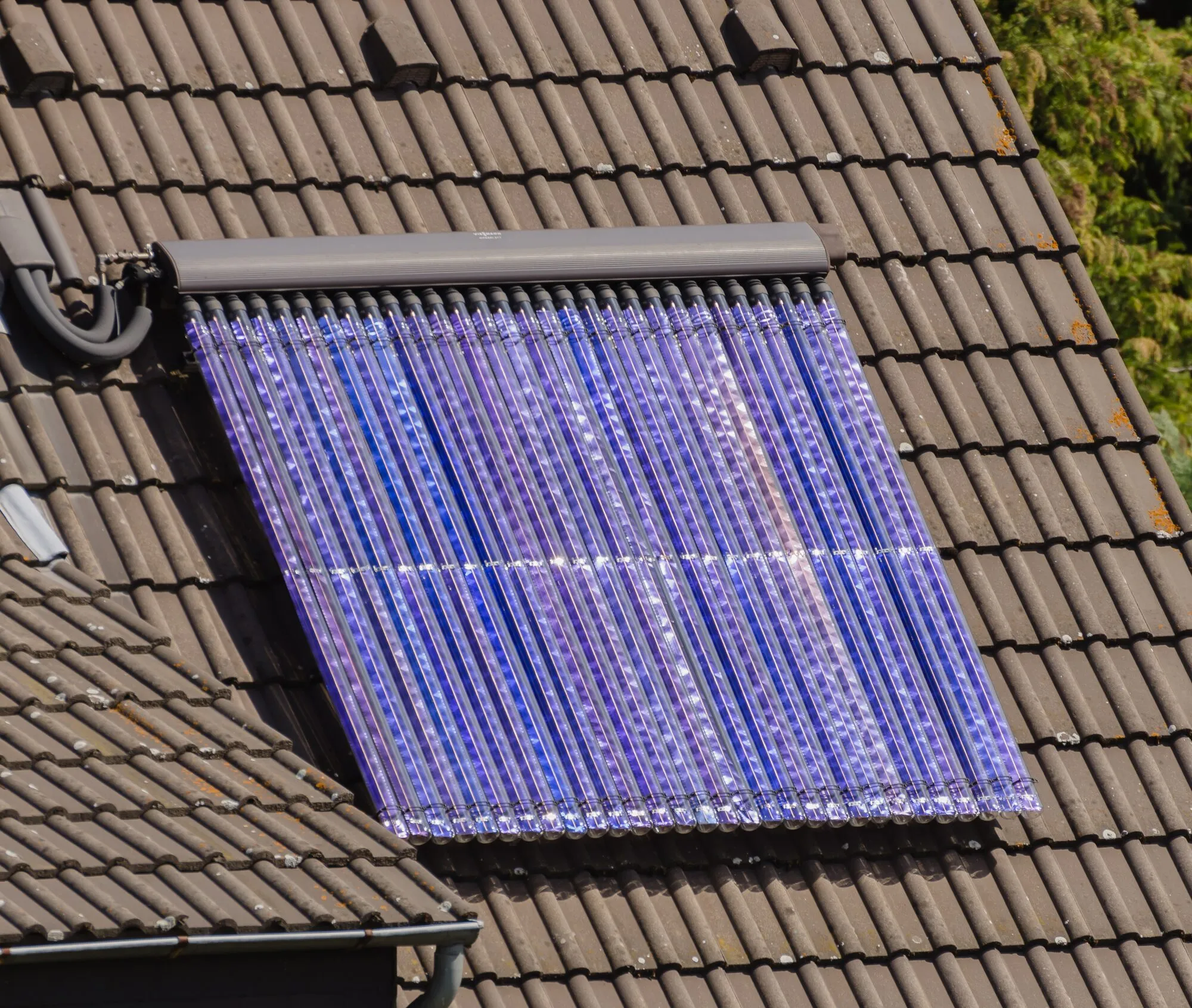
Concentrating and evacuated-tube designs exist but play a minor role (IEA SHC, Solar Heat Worldwide 2025).
How it works
The light budget. On a clear day about 1,000 W of sunlight reaches each square metre of a panel facing the sun; 800 W is a more typical bright hour. A silicon cell converts the part of the spectrum it can use into electricity. The rest is reflected, passes through, or becomes heat in the cell.
Heat makes cells worse. The electrical efficiency of a crystalline silicon cell falls almost linearly with its temperature: η_el = η_ref × (1 − β × (T_cell − 25 °C)), where β is about 0.4% per kelvin (the measured range is 0.2 to 0.5%). In plain words: a panel labelled 20% efficient at 25 °C delivers about 18.4% when its cells sit at 45 °C, which is normal on a sunny day (Skoplaki and Palyvos, 2009).
Collecting the heat. The heat a collector delivers follows the equation in the testing standard EN ISO 9806: η_th = η_0 − a_1 (T_m − T_a) / G − a_2 (T_m − T_a)² / G. Here η_0 is the share of sunlight that becomes useful heat when the fluid is at air temperature (about 61% is typical for PVT), T_m is the mean fluid temperature, T_a the air temperature, G the sunlight in W per m², and a_1, a_2 describe how quickly heat leaks away. In plain words: the hotter you want the water, the less heat you collect, and an uncovered collector, with no glass cover to keep the wind off, loses heat much faster than a covered one.
The trade-off. Cool water helps twice: the cells run cooler and make a little more electricity, and the collector gathers more heat. Hot water hurts twice. This is why PVT and heat pumps are natural partners: a heat pump wants a source at 5 to 20 °C, exactly where an uncovered PVT collector is most efficient. When the fluid is colder than the air, an uncovered collector even draws heat from the air, day and night, which lets it replace the outdoor unit of an air-source heat pump or recharge the ground around ground-source heat pump boreholes. The explainer above lets you try this.
The ratio. Because more of the light becomes heat than electricity, “two or more units of thermal energy are generated for each unit of electrical energy, depending on cell efficiency and system design” (IEA SHC Task 60, 2020).
The limits
Theoretical. Sunlight delivers at most about 1 kW per square metre at noon and, averaged over a year, 100 to 300 W per m² depending on latitude and weather. No collector can deliver more energy than falls on it (except the air-source heat an uncovered collector draws in when it runs colder than the air, which is heat pump physics, not extra sunlight). Electricity is capped by the cell: about a fifth of the light for commercial silicon. Heat is capped by the temperature you need: at 60 °C a collector already loses a large share of what it gathers.
Practical.
- The heat must have a use nearby. Low-temperature heat cannot be sold into a grid like electricity. On a sunny afternoon in July, a house with a full hot water tank has nowhere to put more heat, so the collector stops collecting (“stagnation”) and heats up like an ordinary panel. Sizing the heat side to real demand matters more than any collector detail.
- Temperature limits. Most panels are certified for cell temperatures up to about 85 °C. A covered collector left stagnating in summer can approach that, which ages the encapsulant and solder joints.
- Two trades on one roof. PVT needs an electrician and a plumber, two sets of standards (IEC 61215 and 61730 for the electrical side, EN ISO 9806 for the thermal side) and, until recently, no single test standard of its own. The IEA’s experts list cost, testing and installer skills, not physics, as the barriers (IEA SHC Task 60 position paper).
- Competition from cheap panels. Ordinary panels became so cheap that a roof can often hold separate PV panels and a small solar thermal collector, or PV panels plus an air-source heat pump, for less money than a PVT system.
Real projects, measured
| Project | What it is | What was measured or reported | Source |
|---|---|---|---|
| 26 example systems in IEA SHC Task 60 (Europe and beyond, 2020) | Domestic hot water, heat pump and industrial systems, monitored for about a year | Covered PVT for hot water: up to about 700 kWh of heat per m² a year; uncovered: about 400. Electrical performance ratio 0.66 for covered and 0.75 for uncovered collectors (ordinary PV: 0.7 to 0.85). Heat pump systems using uncovered PVT as their only source reached a seasonal performance factor of about 3 in Switzerland | Schubert and Zenhäusern, 2020 |
| New Town Hall, Freiburg, Germany (2017) | PVT collectors for hot water on a net-plus-energy office building | Designed to deliver 22 MWh of heat a year against a hot water demand of 145 MWh. The measured demand was only 24 MWh a year, so the collector field was far too large, ran hotter and delivered less heat per m². Solar fraction 29.6%; electrical output as expected | IEA SHC Task 60, Existing PVT systems |
| Carrosserie Pfister, Herisau, Switzerland | Uncovered PVT on an industrial building | 106 kWp electrical and 324 kW thermal capacity (rated, not measured output) | IEA SHC, Solar Heat Worldwide 2025 |
| New sports arena, Austria | 1,130 m² of PVT with 80 ground probes and a 540 kW heat pump | Designed to meet a heat demand of 1.4 GWh a year without fossil fuel (design figure) | IEA SHC, Solar Heat Worldwide 2025 |
| World market, 2024 | 46 manufacturers reporting | 37.5 MW thermal and 18.6 MW electrical installed in 2024; France (629,136 m²), Germany and the Netherlands lead | IEA SHC, Solar Heat Worldwide 2025 |
The Freiburg case is the most useful lesson on this page: the collectors worked, the prediction of how much hot water the building would use did not. Published, independently measured data for PVT systems is still scarce; most figures come from pilot projects.

What it costs
| Option | Cost per kWh | Year and source |
|---|---|---|
| PVT, well-dimensioned systems in the Task 60 sample | electricity about €0.20; heat below €0.10 | 2020, Schubert and Zenhäusern |
| PVT, average of the Task 60 sample | electricity €0.10 to €0.15; heat €0.25 (covered) to €0.45 (uncovered) | 2020, same source (depends on how costs are split between heat and power) |
| PVT, modelled | electricity €0.20; heat €0.22 | Lämmle (2019), cited in the same report |
| Benchmark: rooftop solar panels on the same building | about $0.19 central | our Fan Wall model |
| Commercial and community rooftop solar, United States | $0.09 to $0.20 | June 2026, Lazard LCOE+ version 19 |
| Solar thermal hot water, Europe | €0.03 (south) to €0.19 (centre and north) per kWh of heat | 2015, ESTIF, cited by Schubert and Zenhäusern |
| Heat from a gas boiler, EU households | about €0.14 per kWh of heat (fuel only: gas at €0.1228 per kWh, 90% efficient boiler) | second half of 2025, Eurostat |
What the table says: the best PVT systems already make heat for less than a gas boiler’s fuel costs in Europe and electricity at about the price of rooftop panels, but the average pilot system does not. The spread is huge because the value of the heat depends entirely on whether it is used. IEA experts have set the goal of cutting PVT collector costs by a factor of 1.5 to 2 through volume and technology (Task 60 position paper).
Where it can win, and where it cannot
It can win:
- Buildings with a year-round heat demand and a small roof: apartment blocks, hotels, hospitals, swimming pools, laundries, sports halls. Every square metre does two jobs.
- As the heat source for a heat pump. Uncovered PVT can replace a noisy outdoor unit or recharge a borehole field so it does not cool down over the years, which is where most recent growth has come from.
- Warm, sunny places with hot water demand, where covered collectors can meet most of it; a Task 60 system reached a 70% solar share.
- Low-temperature industrial heat (washing, drying, preheating), where there is a use every day of the year.

It cannot win:
- Where the heat has no user. A holiday home, an office with little hot water, or a house already heated by a heat pump with its own outdoor unit may be better served by ordinary panels.
- At high temperatures. Steam and process heat above about 80 °C are beyond what PV cells can tolerate; concentrating solar thermal or thermal storage fits better.
- On price alone against cheap panels, until installation becomes as routine as ordinary PV.
What is proven, plausible and speculative
Proven: the temperature penalty of silicon cells; the collector physics of EN ISO 9806; that PVT collectors deliver both electricity and heat in real buildings, with measured yields of roughly 400 to 700 kWh of heat per m² a year; that uncovered PVT can serve as the sole source for a heat pump with a seasonal performance factor near 3 in Switzerland; that oversizing the heat side lowers the yield.
Plausible: that volume production and standard kits could lower costs by a factor of 1.5 to 2; that PVT plus heat pumps can decarbonise dense city blocks where there is no room for outdoor units or boreholes; that better thermal contact between cells and absorber raises both yields.
Speculative: PVT-driven night-time radiative cooling at useful scale (demonstrated in research, rarely in buildings); long-term durability of the cell-to-absorber bond over 25 years of thermal cycling; building-integrated PVT facades at a competitive price.
Open research questions
- How do cell-to-absorber bonds and encapsulants age under daily thermal cycling and summer stagnation? Twenty-five-year field data does not yet exist.
- What is the right split between PVT, ordinary PV and borehole length in a heat pump system, and how much does PVT regeneration really extend borehole life?
- Can one combined test standard and certification cut the cost and time of bringing a PVT product to market?
- How should installers size the heat side when real hot water demand is so uncertain, as Freiburg showed?
- Can low-cost polymer heat exchangers match metal ones for heat transfer and lifetime?
What a working prototype would need
For an inventor with a new PVT design, the evidence that counts is a collector measured in the sun, with calibrated sensors, for long enough to see both good and bad days.
| Phase | Work | What it proves | Rough cost | Time |
|---|---|---|---|---|
| 0. Desk study | Heat-transfer model of the design, comparison with published collector data, cost estimate | The idea beats existing PVT on paper | $5k to $15k | 1 to 2 months |
| 1. Bench and outdoor test of one collector | Measured electrical output (I-V curves) and thermal efficiency at several fluid temperatures, following EN ISO 9806 and IEC 60891 methods, in an accredited lab or a careful university setup | Real η_0, a_1, and the electrical temperature penalty | $15k to $40k | 3 to 4 months |
| 2. Small system pilot | 10 to 20 m² feeding a real hot water tank or heat pump, with heat meters, electricity meters and weather station, one year | Seasonal yields, stagnation behaviour, reliability | $40k to $100k | 12 months |
| 3. Certification | IEC 61215 and 61730 (electrical safety and durability), Solar Keymark (thermal), building approvals | A product that can be sold and insured | $60k to $150k | 9 to 12 months |
Phases 0 to 2 cost roughly $60,000 to $155,000. These are our estimates from typical laboratory and monitoring costs, not quotes.
Who we need
- Solar thermal engineer with EN ISO 9806 testing experience.
- PV module engineer who understands encapsulants, thermal cycling and IEC 61215.
- Building services (HVAC) engineer to size the heat side and integrate heat pumps and storage.
- Monitoring specialist to design calibrated heat and electricity metering.
- Manufacturing partner able to laminate and bond heat exchangers at volume.
- Installers and plumbers willing to trial a combined installation and report the real labour time.
Have a better idea?
Maybe you have a better absorber, a cheaper way to bond it, or a smarter way to use the heat. Some members of the Local Solar System Foundation may have contacts who could hear a pitch for a strong energy idea. To be pitched, an idea needs a working, real-life model that actually produces power and heat, measured on an instrument, not claimed. Paper ideas are welcome too: if the physics and the numbers are solid, we can publish them here on the website. Raising capital without a working model is very difficult, and we cannot promise funding, returns or introductions.
For PVT, the cheapest measurement that counts as a working model is one collector outdoors next to an identical ordinary panel, with the inlet and outlet water temperatures, the flow rate and both panels’ electrical output logged for a few sunny weeks. That shows the heat gained and the electricity gained or lost. Send it through the contribution form, and see how PVT compares with other ideas on the idea radar.
Sources
- Lämmle, M. et al. (2020). Basic concepts of PVT collector technologies, application areas and market. IEA SHC Task 60, Report D5.
- Skoplaki, E. and Palyvos, J.A. (2009). On the temperature dependence of photovoltaic module electrical performance: a review of efficiency/power correlations. Solar Energy 83(5), 614-624.
- AEE INTEC and IEA SHC (2025). Solar Heat Worldwide, 2025 edition, chapter 5.4, Photovoltaic-thermal systems.
- IEA PVPS (2025). Snapshot of Global PV Markets 2025.
- IEA SHC Task 60 (2020). PVT technology position paper.
- Schubert, M. and Zenhäusern, D. (2020). Performance assessment of example PVT systems. IEA SHC Task 60, Report D2.
- IEA SHC Task 60 (2020). Existing PVT systems and solutions, including the New Town Hall Freiburg fact sheet (after Réhault et al., 2019).
- ISO (2017). ISO 9806:2017, Solar energy: solar thermal collectors, test methods.
- Chow, T.T. (2010). A review on photovoltaic/thermal hybrid solar technology. Applied Energy 87(2), 365-379.
- Herrando, M., Markides, C.N. and Hellgardt, K. (2014). A UK-based assessment of hybrid PV and solar-thermal systems for domestic heating and power: system performance. Applied Energy 122, 288-309.
- Lazard (June 2026). Levelized Cost of Energy+, version 19: community and C&I solar $88 to $197 per MWh.
- Eurostat (2026). Natural gas price statistics: EU household average €0.1228 per kWh, second half of 2025.
- Local Solar System Foundation (2020, model updated 2026). The Fan Wall: open model, rooftop solar benchmark.