
Ground-source heat pumps
A few metres down, the ground stays at the same mild temperature all year. A heat pump can use that steady warmth to heat a home with a quarter of the electricity a heater would need. The physics is excellent; the price of the hole is the problem.
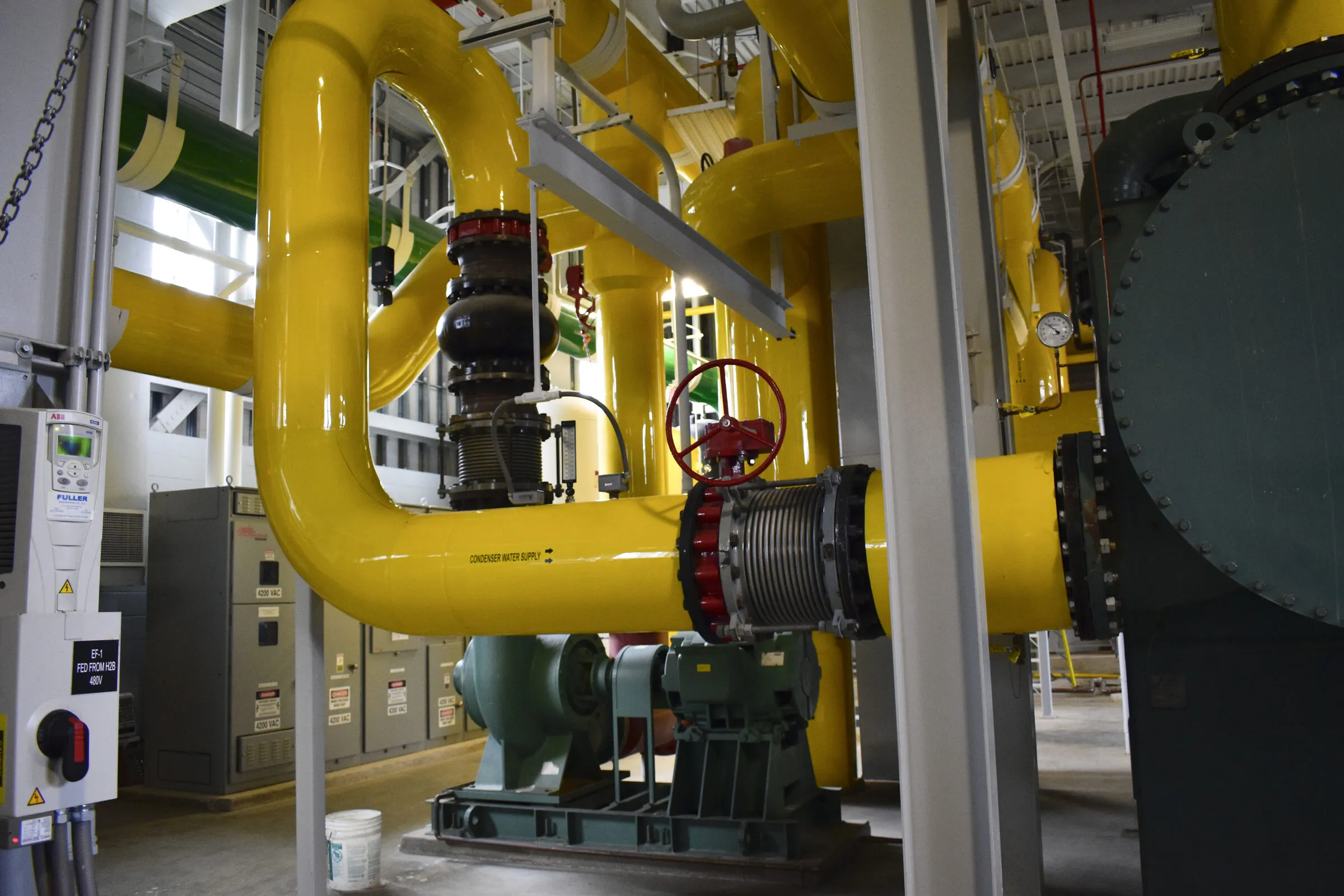
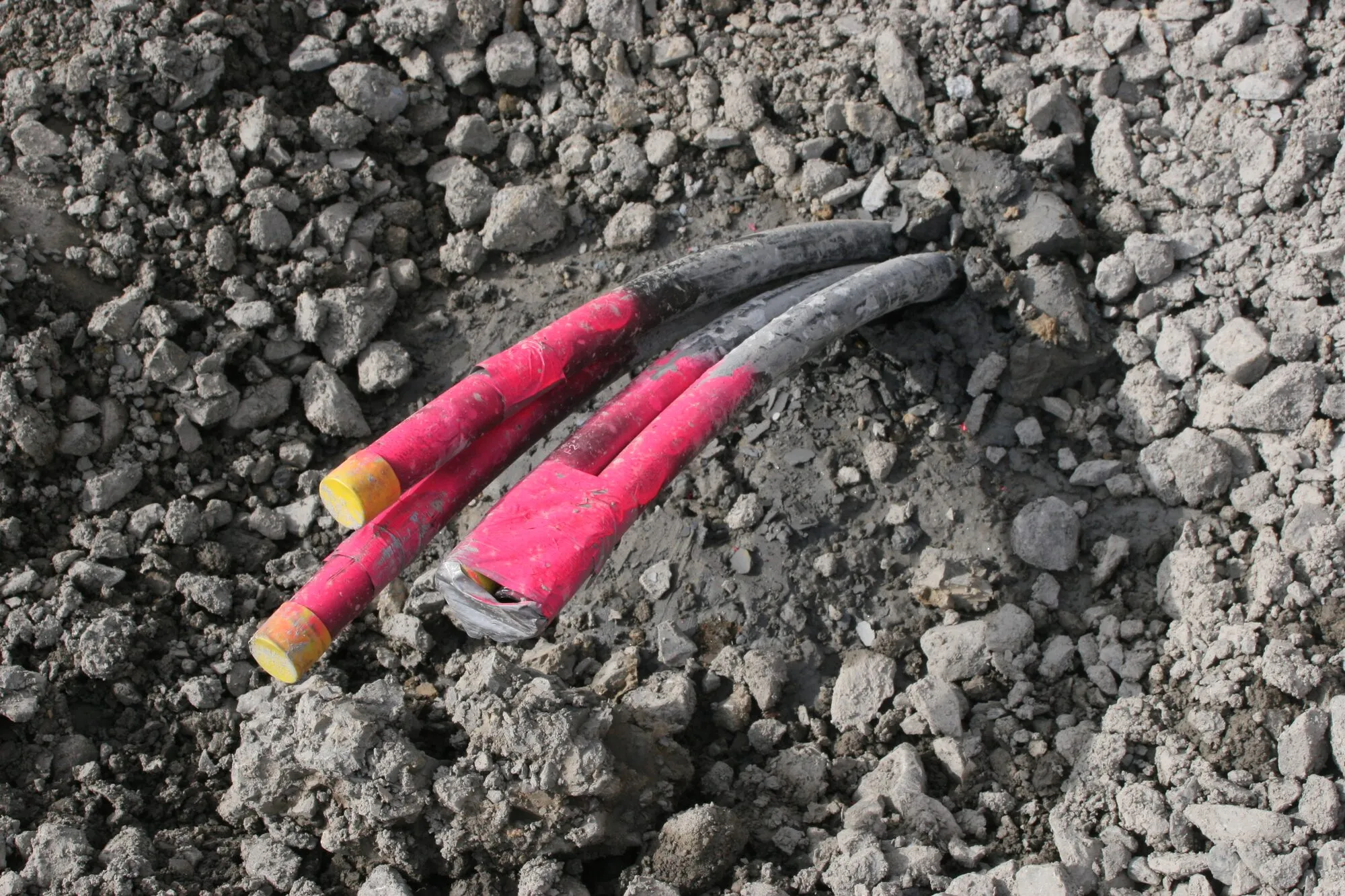
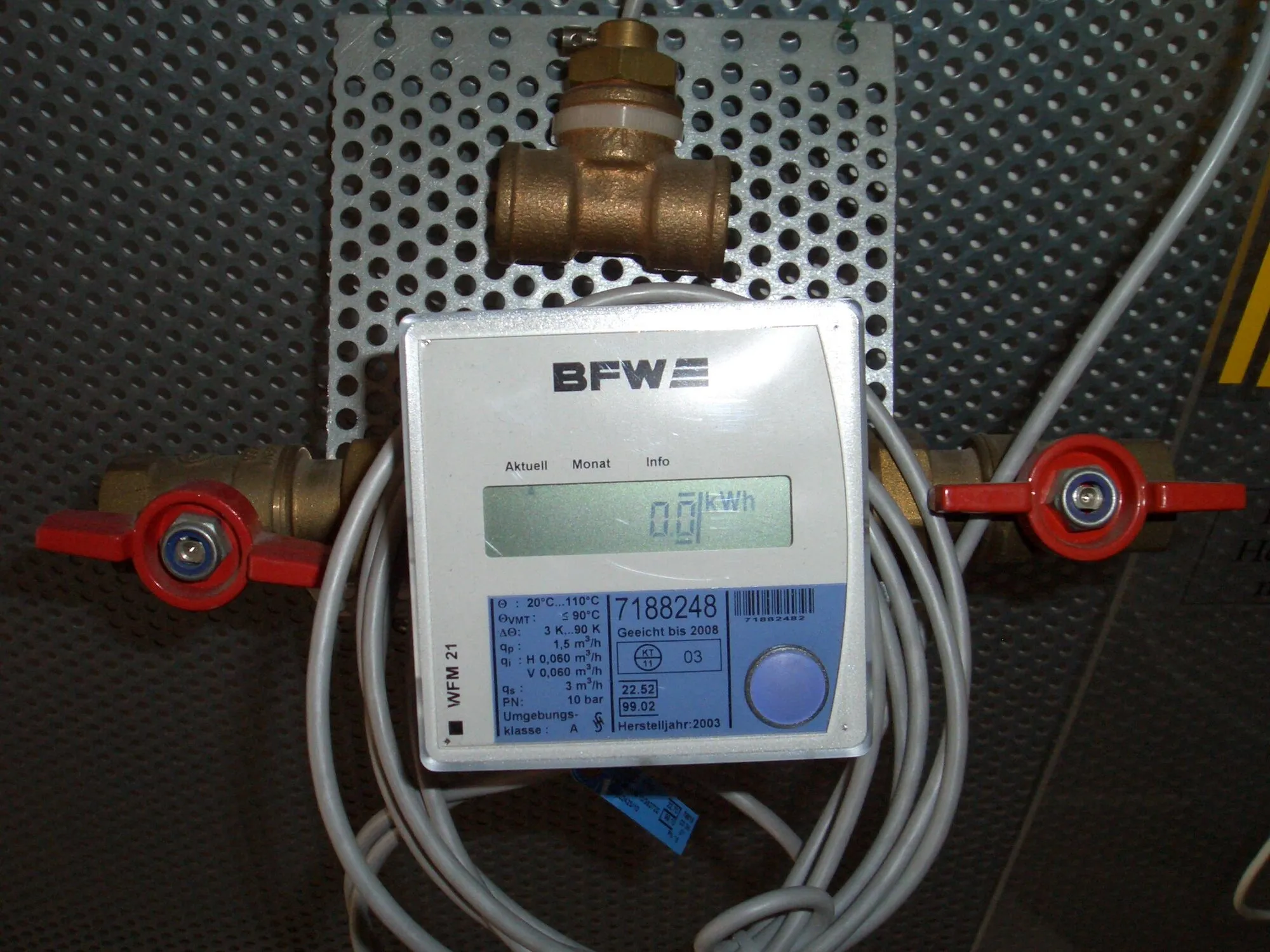
Paul Gipe / Wikimedia Commons (CC BY-SA 4.0)
In 2017 Ball State University in Indiana shut the last of the four coal-fired boilers that had heated its campus for decades. In their place it drilled about 3,600 boreholes under its grounds and connected them, through two energy stations, to heat pumps that warm and cool the campus. The system cost about $65 million, and the university committed to cutting its greenhouse gas emissions by nearly 80,000 tons a year (Wikipedia, Ball State University).
A ground-source heat pump is not a new source of energy. It is a multiplier: it uses electricity to move heat that is already in the ground into a building, and delivers three to five units of heat for each unit of electricity it uses (IEA, 2022). It is mature, reliable and quiet. It is also expensive to install, which is why this page spends as much time on cost as on physics.
What it is
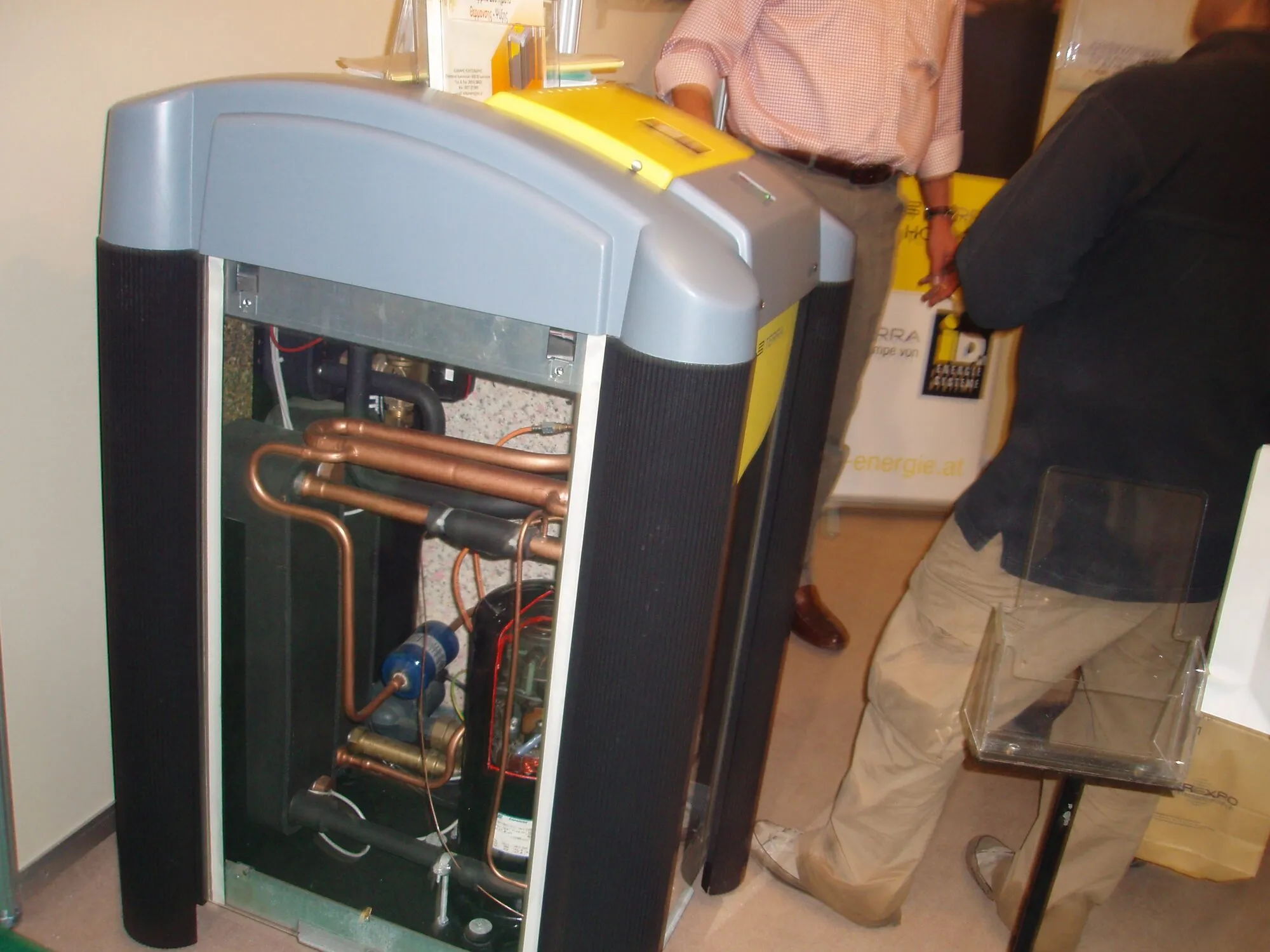
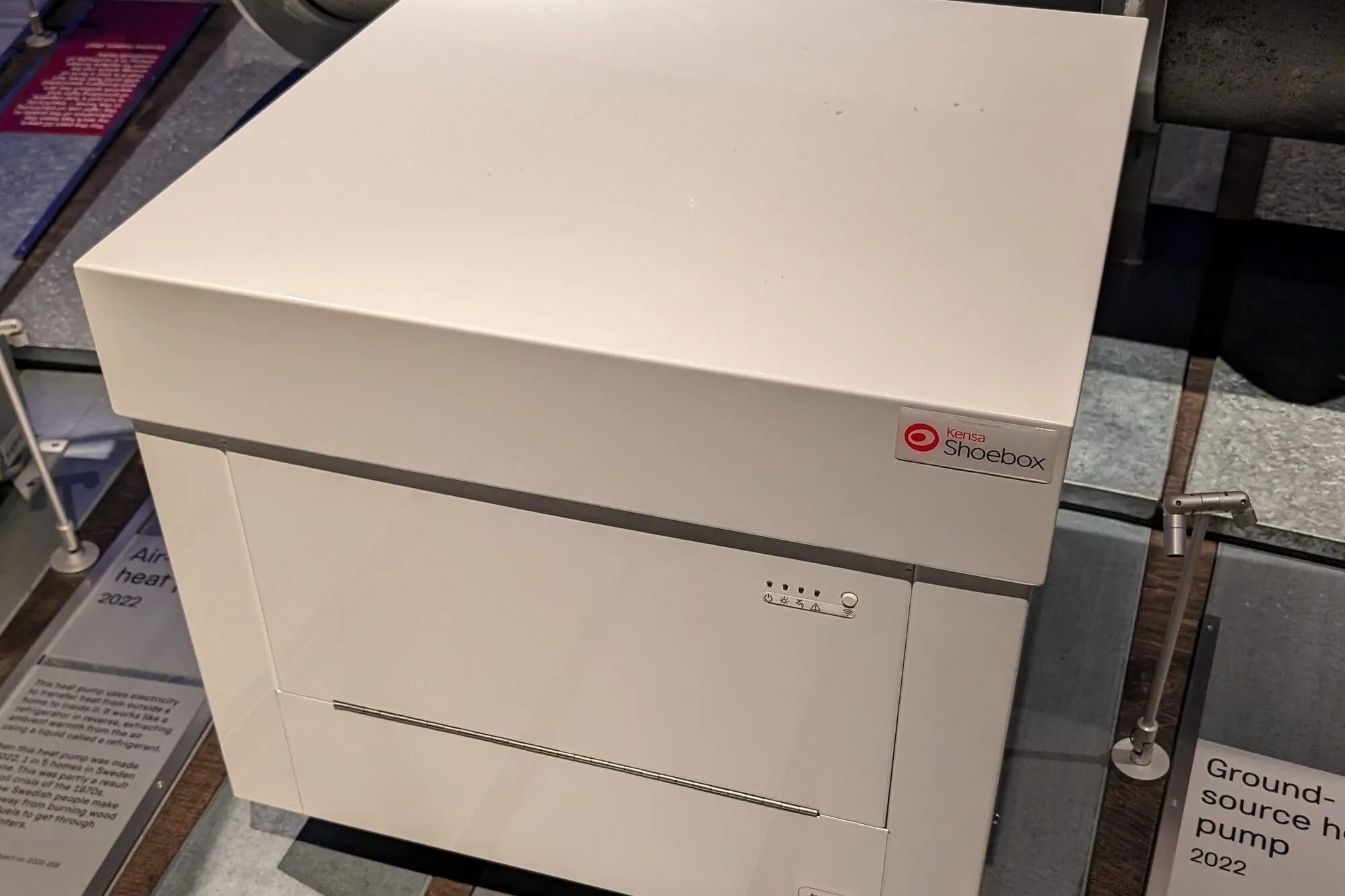
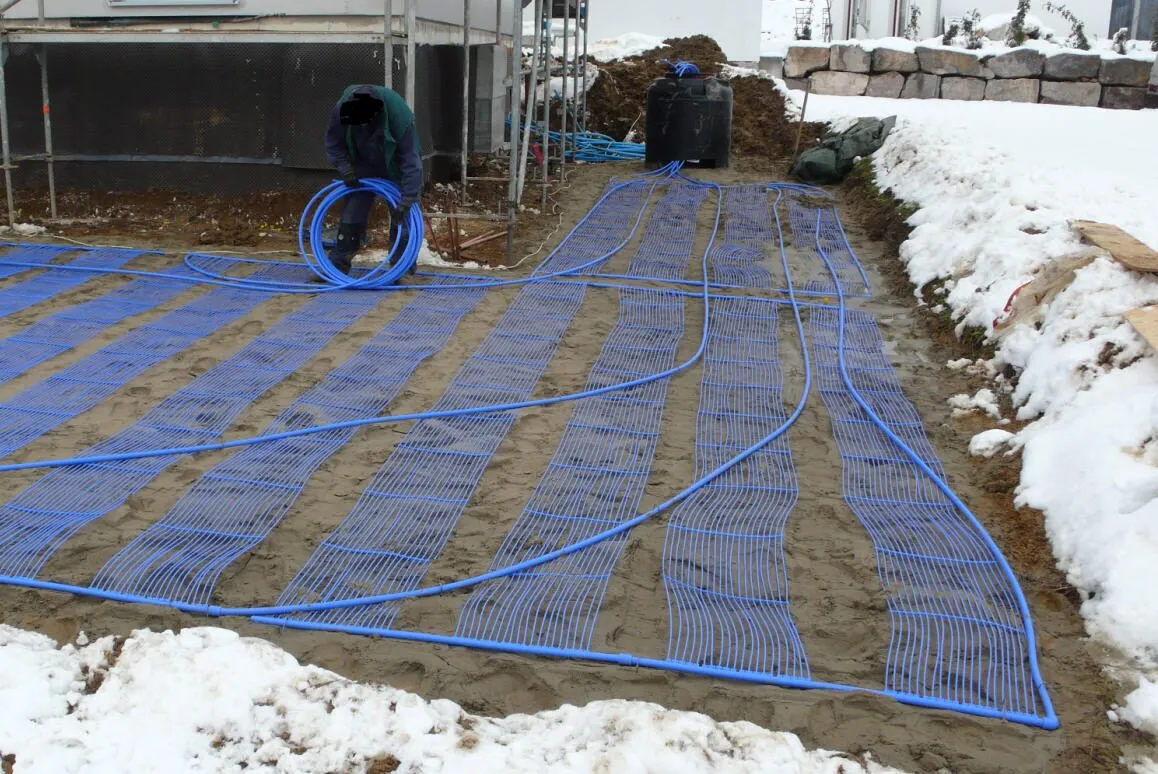
A ground-source heat pump has three parts: a ground loop of plastic pipe buried in trenches or dropped into boreholes, filled with water and antifreeze; a heat pump the size of a fridge, usually indoors; and a heat distribution system, such as radiators or underfloor heating. In winter the fluid in the loop picks up heat from the ground and the heat pump concentrates it to 35 to 55 °C for the house. In summer the same machine can run in reverse, cooling the building and putting heat back into the ground.
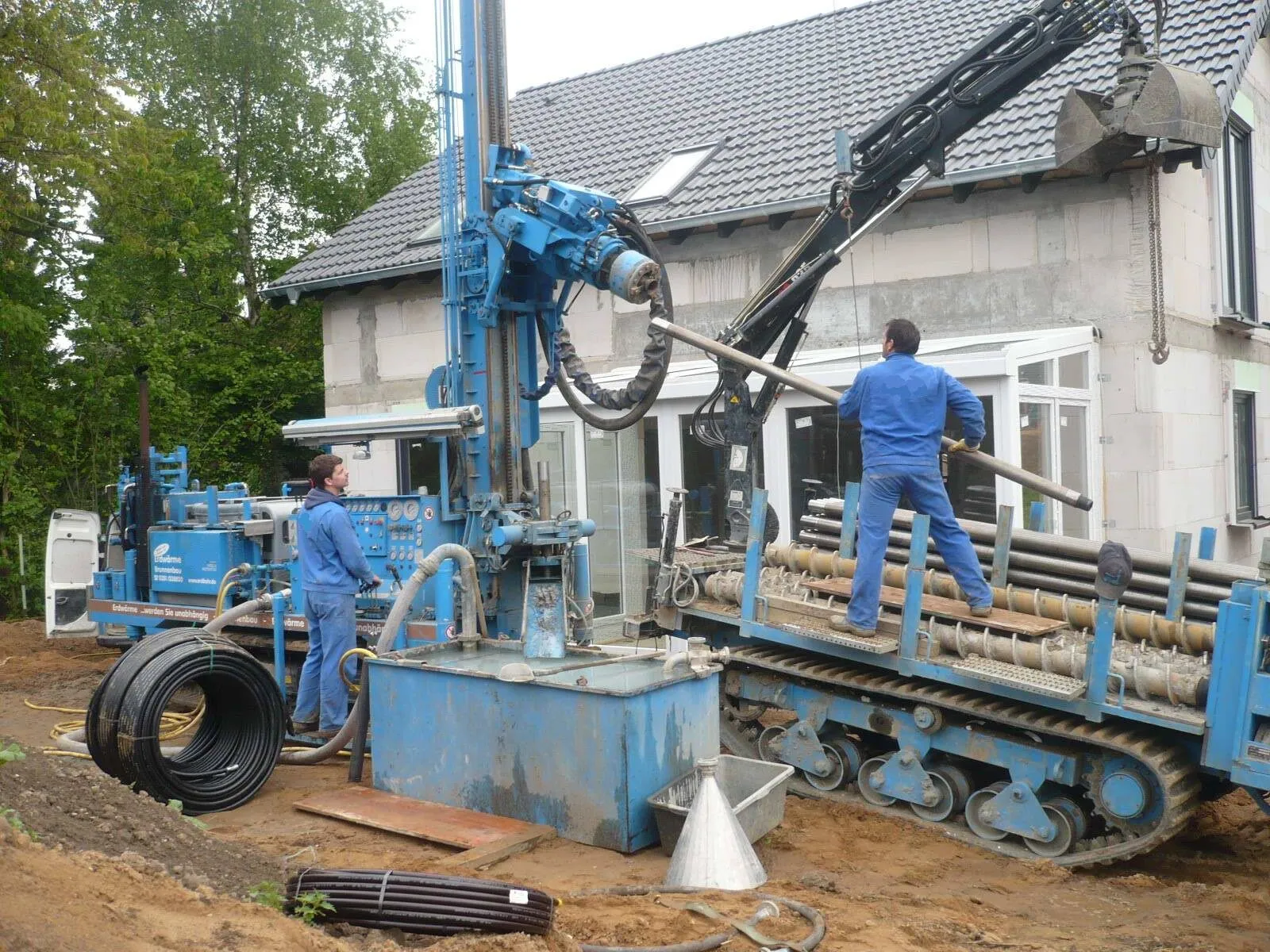
Small homes with gardens can use horizontal loops laid 1 to 2 m deep. Most other buildings use vertical boreholes, typically 15 to 150 m deep; a detached house needing 10 kW of heat might need three boreholes of 80 to 110 m (Wikipedia, Ground source heat pump). Whole streets and campuses can share one field of boreholes through a thermal network: an ambient-temperature water loop that connects many buildings, each with its own heat pump.
How it works
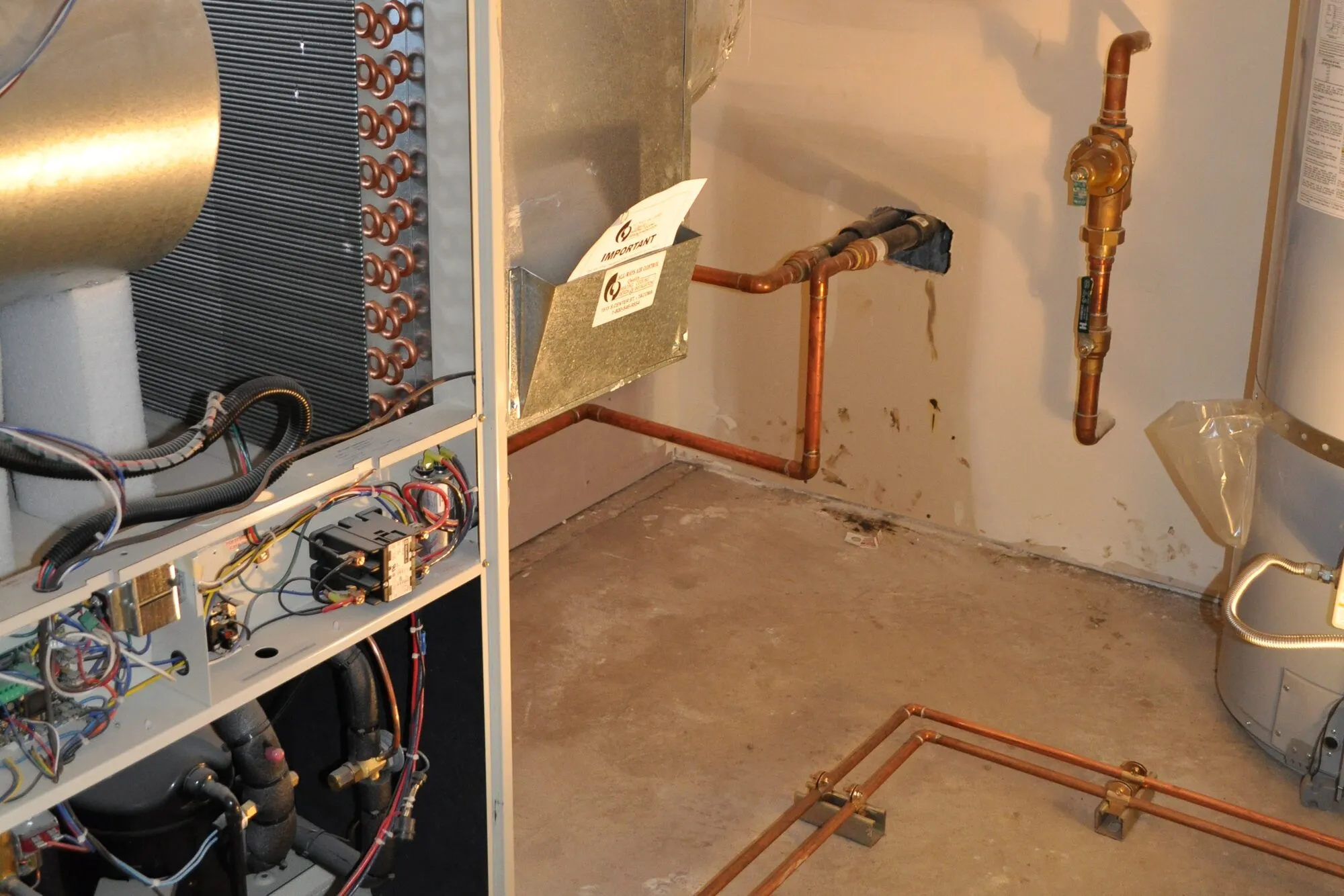
A heat pump is a refrigerator turned inside out. A working fluid (the refrigerant) evaporates at low temperature in a heat exchanger connected to the ground loop, absorbing heat. A compressor squeezes the vapour, which raises its temperature. In a second heat exchanger it condenses and releases that heat into the water going to the radiators. An expansion valve drops the pressure and the cycle starts again.
The multiplier. The heat delivered divided by the electricity used is the coefficient of performance, COP. The best any heat pump can ever do is the Carnot COP:
COP_max = T_hot / (T_hot − T_cold), with temperatures in kelvin.
Delivering water at 40 °C (313 K) from ground at 5 °C (278 K) after heat-exchanger losses gives 313 / 35 ≈ 8.9. Real machines reach roughly half of the Carnot figure, so about 4.5. Two things follow directly from the equation:
- The lift matters more than anything. Every degree between the source and the radiators costs efficiency. Raising the flow temperature from 35 °C to 55 °C drops our modelled ground-source COP from about 4.5 to 3.0. Larger radiators or underfloor heating, which work at lower temperatures, make every heat pump better.
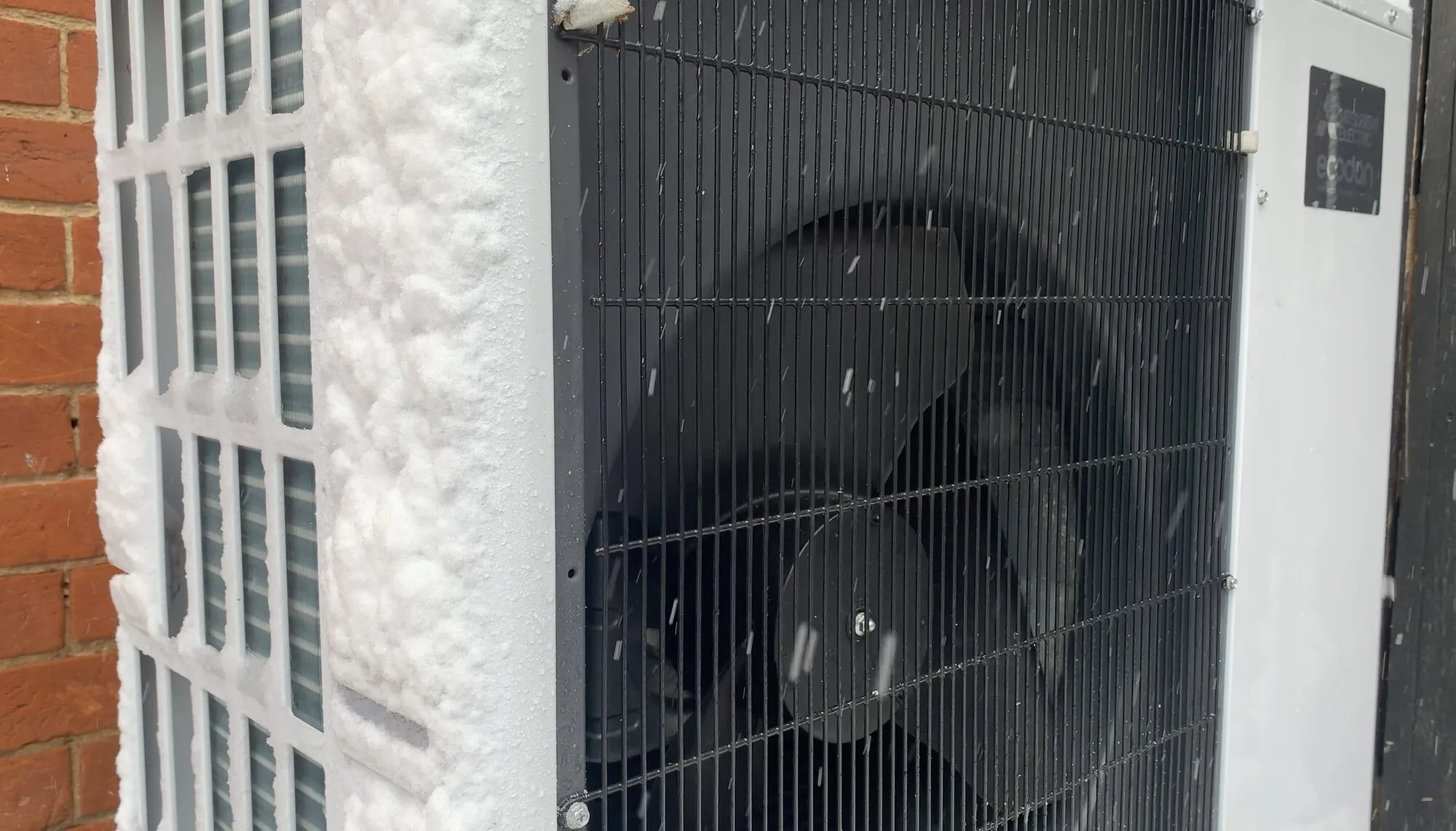
- The source temperature matters. Outdoor air is coldest exactly when heat is most needed. At −7 °C and 55 °C flow, an air-source unit in our model falls to about 2.3; the ground, at about 10 °C, gives 3.0 at the same flow temperature. That is the ground’s whole advantage.
The ground is a slow battery. A few metres down, daily swings vanish; by 10 to 20 m the ground sits close to the local average annual air temperature, and deeper it warms by about 0.025 °C per metre (Wikipedia, Ground source heat pump). The heat in it comes mostly from the sun warming the surface, not from the Earth’s core. A borehole that only ever extracts heat slowly cools the rock around it over the years, and a closely packed field of boreholes can cool faster than the ground recovers. Putting heat back in summer, by cooling buildings, keeps the balance. That is why shared networks that mix heating and cooling loads work so well.
The seasonal number. The COP on a spec sheet is measured at one test condition. What matters is the seasonal performance factor (SPF): the heat delivered over a whole year divided by all the electricity used, including pumps and backup heaters. Field tests measure SPF, and it is always lower than the laboratory COP.
The limits
- Physics. The Carnot limit caps the COP for a given lift; no refrigerant or compressor escapes it. Real machines are already at about half of it, and the best at a little more.
- Ground capacity. Each metre of borehole can deliver only a few tens of watts of heat, depending on the rock and groundwater, so a building’s heat demand sets how many metres must be drilled. Drilling is the biggest single cost.
- Space and access. Drilling rigs need access; dense city blocks, listed buildings and small plots may have nowhere to drill.
- Building quality. A leaky house with small radiators needs a high flow temperature, which cuts the COP; insulation and bigger emitters often come first.
- Electricity prices. The running cost depends on the price of electricity divided by the price of the fuel it replaces. Where electricity costs more than three times as much as gas per kWh, as in the UK, the heat pump needs a yearly COP near 3 just to break even on running costs.
- Skills. Good design and commissioning make a large difference to real SPF, and installer skills are scarce in many countries.
Real projects, measured
| Project | Where, when | Scale | What is reported |
|---|---|---|---|
| Fraunhofer ISE field test, WPsmart im Bestand | Germany, existing homes built between 1850 and 2001, monitoring from 2017 | Air-source and ground-source systems in occupied homes | Yearly SPF: ground source about 4.1 (range about 3.3 to 4.7), air source about 3.1 (range about 2.5 to 3.8) (Fraunhofer ISE) |
| Ball State University geothermal system | Muncie, Indiana, USA, completed 2017 | About 3,600 boreholes, two energy stations, about $65 million | Replaced all four coal-fired boilers; the university committed to nearly 80,000 tons a year less greenhouse gas (Wikipedia) |
| Eversource networked geothermal pilot | Framingham, Massachusetts, USA, 2024 | About three dozen homes and municipal buildings on a one-mile loop | First utility-run thermal network in the US; a school administration building, a fire station and public housing among the users; about $18.6 million; the network is planned to double in size (PBS NewsHour, 2025) |
| Colorado Mesa University geo-exchange | Grand Junction, Colorado, USA | 16 buildings, 1.2 million square feet, on a shared ambient loop | Provides 90% of the campus heating and cooling; the university reports $1.5 million a year of energy savings (US DOE case study) |
| Boiler Upgrade Scheme | England and Wales, 2022 to 2026 | 82,651 grants paid for heat pumps and biomass boilers by April 2026 | Ground source is a small minority: 98% of applications were for air-to-water heat pumps (DESNZ, 2026) |
Europe’s fifth-generation heat networks, ambient-temperature loops that share heat between buildings through individual heat pumps, have been reviewed across dozens of sites (Buffa et al., 2019). Their efficiency depends heavily on how well heating and cooling demands balance.
What it costs
A heat pump does not generate electricity, so the comparison with our site-wide benchmark (rooftop solar at about $0.19 per kWh in the Fan Wall model, within Lazard’s June 2026 range of $0.09 to $0.20 for commercial rooftop solar) is indirect: a ground-source heat pump turns each kWh of that solar electricity into about four kWh of heat. The direct competitor is a gas boiler, and the fair measure is the cost per kWh of heat, including the installation.
We use UK figures because they are public and recent: median installed costs from the Boiler Upgrade Scheme for January to March 2026 (£27,352 for ground source, £13,100 for air source, both including VAT) (DESNZ); the £7,500 grant; price-cap unit rates for October to December 2026 of 26.32p per kWh of electricity and 7.97p per kWh of gas (Ofgem); the Fraunhofer field SPFs; a home using 12,000 kWh of heat a year; and 20 years at a 7% real discount rate, as on our wind page. For the gas boiler we assume £3,000 installed and 90% efficiency.
| Heating system | Installed cost | Running cost per kWh of heat | Total cost per kWh of heat, no grant | With the £7,500 grant |
|---|---|---|---|---|
| Gas boiler | £3,000 (assumed) | 8.9p | 11.2p | not eligible |
| Air-source heat pump, SPF 3.1 | £13,100 | 8.5p | 18.8p | 13.9p |
| Ground-source heat pump, SPF 4.1 | £27,352 | 6.4p | 27.9p | 22.0p |
Our calculation. Standing charges and maintenance are left out; they are similar across the options.
The table is uncomfortable, and it should be. At UK prices, a ground-source heat pump for a single home costs about twice as much per kWh of heat as gas, even with the grant, almost entirely because of the installation. The running cost is already lower. The picture changes when:
- Electricity is cheaper relative to gas, as in Sweden, Norway and France, or with a time-of-use tariff.
- The ground loop lasts longer than 20 years. Well-installed boreholes are expected to outlive several heat pumps; spread over 50 years instead of 20, the yearly cost of the loop falls by about a quarter.
- Many buildings share one borefield, cutting design, mobilisation and drilling cost per home, and letting cooling loads recharge the ground.
- The alternative is oil, LPG or direct electric heating, which cost more than gas.
- The building needs cooling as well as heating, which the same system provides at little extra cost.
Where it can win, and where it cannot
It can win:
- Campuses, hospitals, offices and new housing estates, where one borefield serves many buildings and both heating and cooling are needed.
- Off-gas-grid homes and farms replacing oil or LPG.
- Cold climates, where air-source heat pumps struggle in the coldest weeks and the ground keeps its temperature.
- Streets rebuilding their gas network. Utility-run thermal networks, like Framingham’s, could replace ageing gas pipes with shared water loops.
- New buildings, where boreholes can be drilled before foundations and underfloor heating keeps the flow temperature low.
It cannot win:
- Single existing homes where gas is cheap and electricity dear, as the cost table shows, unless the installation price falls sharply.
- Dense, old city blocks with no space to drill.
- Poorly insulated buildings with small radiators, until the building is improved.
- As a source of electricity. It uses electricity; it does not make it.
What is proven, plausible and speculative
Proven: the Carnot limit and the importance of low temperature lift; stable ground temperatures; field-measured yearly SPFs around 4 for well-designed ground-source systems; decades of reliable operation in Sweden, Switzerland, Germany and North America; campus-scale systems replacing coal and gas.
Plausible: utility-owned thermal networks that make ground-source heat affordable for ordinary streets; much cheaper drilling through better rigs, standard designs and scale; borefields that store summer heat for winter use.
Speculative: installed costs close to those of a gas boiler for single homes; heat pumps widely exceeding 60% of the Carnot limit in the field; deep boreholes (500 m and more) becoming cheap enough for dense city use.
Open research questions
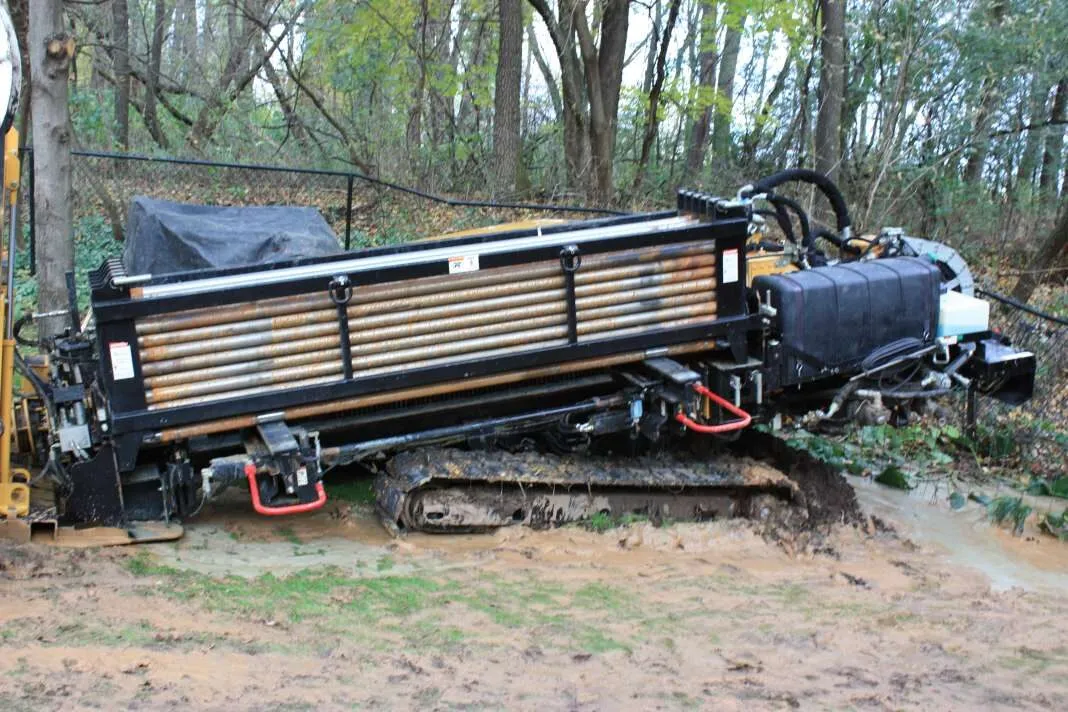
- Cheaper drilling. Drilling can be the largest cost of a ground-source system. Faster rigs, shallower dense arrays, energy piles in foundations and horizontal directional drilling all need real cost data.
- Network design. How to size shared loops and borefields so that heating and cooling balance over decades, and who should own them.
- Real performance at scale. Independent monitoring of networks like Framingham’s: yearly SPF, pumping energy, ground temperature trends and customer bills.
- Low-GWP refrigerants. Propane and CO2 heat pumps with high efficiency and safe installation indoors.
- Grid effects. How millions of heat pumps change winter peak demand, and how ground-source systems reduce it compared with air source.
- Retrofit pathways. The cheapest order of insulation, radiator upgrades and heat pumps for different types of home.
What a working prototype would need
Heat pumps themselves are mature; the useful ideas are in cheaper ground loops, shared networks and smarter control. A working model should deliver measured heat, with metered electricity in and heat out.
| Phase | Work | Decision it enables | Rough cost | Time |
|---|---|---|---|---|
| 1. Desk study | Heat demand of real buildings, ground data from geological surveys, loop design with standard software, cost quotes from drillers | Is the idea cheaper per kW than today’s boreholes? | $5k to $20k | 2 to 3 months |
| 2. Test loop | One borehole or one new ground-exchanger design with a thermal response test, a small heat pump, heat and electricity meters, ground temperature sensors | Measured heat per metre and SPF over a winter | $30k to $80k | 6 to 12 months |
| 3. Street pilot | 5 to 20 buildings on a shared loop, a year of metered data, customer bills | Real cost per home and per kWh of heat | $0.5M to $3M | 18 to 24 months |
Who we need
- Geologists and hydrogeologists to read the ground and model borefields.
- Drilling contractors willing to test new methods and share real costs.
- Heat pump and HVAC engineers for design, commissioning and monitoring.
- District energy and utility planners for shared networks and ownership models.
- Building-physics specialists for retrofit sequencing and low-temperature emitters.
- Economists and tariff designers to price heat fairly and reward flexibility.
Have a better idea?
Some members of the Foundation may have contacts who could hear a pitch for a strong energy idea. To be pitched, an idea needs a working, real-life model that actually produces power; for a heat idea like this one, that means a model that delivers measured heat, with its output and its electricity use logged on instruments, not claimed. Paper ideas are welcome too: if the physics and the numbers are solid, we can publish them here on the website. But raising capital without a working model is very difficult, and nothing here is a promise of funding, returns or introductions.
Send your idea through the contribution form with the problem it solves, the physics check, a rough cost per kWh of heat, and the cheapest test that could prove it wrong. If you have a working model, include its measured output and how you measured it. The energy sources page compares this and the other alternatives on the idea radar.
Sources
- Wikipedia. Ball State University: geothermal system completed in 2017.
- IEA (2022). The Future of Heat Pumps.
- Fraunhofer ISE. WPsmart im Bestand: heat pumps in existing buildings, field test.
- Wikipedia. Ground source heat pump: borehole depths, ground temperatures and the geothermal gradient.
- Department for Energy Security and Net Zero (2026). Boiler Upgrade Scheme statistics, April 2026, tables Q1.1A and 1.1.
- Ofgem (2026). Energy price cap unit rates, 1 October to 31 December 2026.
- PBS NewsHour (2025). Unlikely alliance builds cleaner geothermal energy network in Massachusetts community.
- US Department of Energy. Geothermal heat pump case study: Colorado Mesa University.
- Buffa, S., Cozzini, M., D’Antoni, M., Baratieri, M. and Fedrizzi, R. (2019). 5th generation district heating and cooling systems: a review of existing cases in Europe. Renewable and Sustainable Energy Reviews 104, 504-522.
- Staffell, I., Brett, D., Brandon, N. and Hawkes, A. (2012). A review of domestic heat pumps. Energy and Environmental Science 5, 9291.
- Lazard (June 2026). Levelized Cost of Energy+, version 19.
- Local Solar System Foundation. The Fan Wall open model: the rooftop solar benchmark of $0.19 per kWh.
- Kusuda, T. and Achenbach, P.R. (1965). Earth temperature and thermal diffusivity at selected stations in the United States. National Bureau of Standards Report 8972.
- Wikipedia. Vapor-compression refrigeration: the evaporator, compressor, condenser and expansion valve.
- Wikipedia. Directional boring: trenchless drilling in a shallow arc.